Loading this candidate’s profile from the FEC filings and campaign records.
Where They Stand is a nonpartisan guide to everyone running for Congress: their money, their own words and how incumbents voted. Find your ballot →
Candidates › MI-12 race › 2025–2026
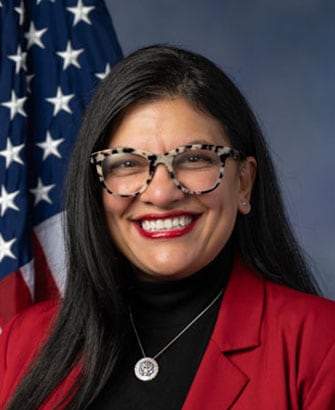
Rashida Tlaib
D Democratic nominee for U.S. House, MI-12
Representative since 2019
Other accounts (2)
The same platforms’ other accounts, such as a congressional office’s or an earlier campaign’s.
- On the ballot
- Won the general electionNov 3, 2026 · 179,813 votes (60.0%)
- Where to vote
- Find your polling place (opens in a new tab) · More ways to vote
- Top priorities
- Economic and Housing Justice
- Racial and Immigration Justice
- Environmental Justice
- Quality Healthcare For All
- Gender Justice & LGBTQI+ Rights
- In Congress
- Representative since 2019 · votes with their party 94% of the time. See the record · Office phone 202-225-5126
- Money
- $3.3M raised, $4.5M spent, $3M cash on hand (through Oct 14, 2026). Where it comes from
- Who gives
- 37% of individual money from donors at $200 or less · 8.4% from Michigan · largest committee giver AMERICAN FEDERATION OF STATE COUNTY & MUNICIPAL EMPLOYEES P E O P L E, $10K
- Outside groups
- $10 supporting Tlaib
- Backed by
- 12th Congressional District Democrats · All* In Action Fund · American Federation of Governmental Employees (AFGE) Local 704 and 52 more. As the campaign lists them
- Sponsored most in
- International Affairs, Finance and Financial Sector, Immigration
6 priorities from rashidaforcongress.com, in the order they are listed there. Every heading and the text under it is copied exactly, as one passage for each page it is from, and links to that place on the page; hover a source to see which passage it opens.
From workers’ rights to monthly payments in people’s pockets, Rashida fights for economic & housing justice for all.
Rashida Tlaib’s Housing Our Communities Act passed into law in July 2026, ensuring more affordable housing across the country.
Her visionary economic legislation includes plans for a near-universal basic income without increasing public debt. Her proposal also includes creating jobs in a new Emergency Response Corps to check in on unhoused people and others in need. Early in the pandemic Rashida led the fight to get stimulus payments directly into people’s pockets every month because one-time relief payments are not enough.
Serving on the U.S. House of Representatives’ Financial Services Committee, Rashida holds big banks accountable, levels the playing field for credit reporting (which affect people’s ability to get housing, jobs, auto insurance, and more), and keeps pushing for ways to make banking more accessible—especially when it comes to increasing homeownership. She worked with the Biden administration to clear medical debt off 15 million Americans’ credit reports, and she’s pushing to cancel medical debt, utility debt, and student debt.
Throughout Rashida’s life she has joined striking workers and has supported workers’ rights, from the perspective of someone who truly understands what it’s like to struggle financially. When Rashida’s father joined a union, her family was able to get healthcare for the first time. She believes that supporting our workers is at the core of fighting against corporate greed. We all deserve to feel safe at work and make a wage that truly values the work we put in for ourselves and our families.
Rashida is also addressing Michigan’s and the nation’s decline in Black homeownership, which is at the lowest rate in nearly 50 years. Rashida has focused on housing justice and investing in home repair—one of the top issues our campaign has encountered from residents as we’ve checked in about their top priorities. Homeownership is a vital part of economic stability for families across the nation.
Rashida is also an unwavering advocate for tenants, fighting predatory landlords and lenders side-by-side with grassroots housing justice groups, as well as expanding banking opportunities and access to credit. She’s also challenging Detroit’s discriminatory property tax system that taxes the least expensive homes at six times the rate of the most expensive homes.
Here are some of the ways Rashida has fought for economic and housing justice since serving in Congress.
Housing justice ↗ (opens rashidaforcongress.com/issues/economic-and-housing-justice at this heading)
- Passed the Housing Our Communities Act into law, which will fund and build affordable housing across the country. She knows that housing is a human right.
- Passed a bill to expand homeownership opportunities by pushing for more support for small-dollar mortgages: the Improving FHA Support for Small Dollar Mortgages Act of 2021.
- Secured $3 billion for the Restoring Communities Left Behind Act, which funds home repairs and neighborhood revitalization, as well as homeownership and financing assistance to low-income households. It passed the U.S. House through the Build Back Better Act package.
- Introduced the Tenant Empowerment Act, bold legislation to strengthen HUD tenant protections and provide them with the tools necessary to improve the quality of their homes.
- Pushed not only for a national eviction moratorium, but to cancel mortgage and rent payments during the pandemic, including debt forgiveness and protecting people’s credit ratings and rental history.
- Held hearings in the House Committee on Financial Services for her bill the No Biometric Barriers Act, which would prohibit dangerous and potentially unconstitutional biometric technology, such as facial recognition technology, from being used in federal public housing.
- Held a housing justice congressional hearing in her district, as well as a neighborhood housing tour with the chairman and members of the House Financial Services Committee. Local community experts spoke about the institutionalized discrimination that’s caused our housing affordability crisis and how we must address the crisis by expanding civil rights protections and investment in affordable housing.
- Created a local legislative working group to address housing access.
- Rashida has helped ensure that her district was included in the latest CDC eviction moratorium, even explicitly thanked by a district court judge for clarifying the law and keeping Detroit families in their homes.
- Secured millions of dollars for housing and home repairs in her district, including $2.5 million for low-income senior housing, over $1.1 million for affordable permanent supportive housing for at-risk families, $3 million for home repairs, and $1 million for affordable and identity-affirming housing for Black and Brown LGBTQ+ youth.
Credit scores, banking, and auto industry accountability ↗ (opens rashidaforcongress.com/issues/economic-and-housing-justice at this heading)
- Passed a bill that would remove medically necessary debt from credit reports. Medical debt is the leading cause of personal bankruptcy in our country, but undergoing a medically necessary procedure should never haunt someone financially. That’s why Rashida also passed the Restoring Unfairly Impaired Credit & Protecting Consumers Act, which reduces time negative credit stays on a credit report from 7 years to 4 years. The bill also protects people’s credit reports from predatory activity, fraud, and medically necessary debt—all things that can lower credit scores and can thus lead to being denied housing, employment, transportation, and other necessities. Rashida also secured an amendment in the National Defense Authorization Act to protect veterans from medically necessary debt on their credit reports.
- Introduced three bills to prohibit the use of non-driving factors in auto insurance rates, such as education, employment status, credit score, zip code, and homeownership status. Right now, people with higher credit scores but DUIs pay less than people with good driving records but lower credit scores. That’s unacceptable discrimination and redlining, which punishes people just for being poor, and disproportionately punishes communities of color.
- Successfully pushed the federal government to send people COVID stimulus money via prepaid debit cards rather than checks—ensuring accessibility for the 25% of Americans who are unbanked or underbanked.
- Introduced the Public Banking Act to open doors for marginalized people who have been systematically shut out of our nation’s private banks.
- Held two congressional hearings in Washington D.C. on discriminatory practices by the auto insurance industry.
Workers’ rights ↗ (opens rashidaforcongress.com/issues/economic-and-housing-justice at this heading)
- Signed into law the Payee Fraud Prevention Act, putting an end to fraudulent activity that targets vulnerable retirees and their pensions.
- Passed an amendment to the Protecting Older Workers Against Discrimination Act, to protect federal employees from age discrimination.
- Secured amendment #16 in the House-passed PRO (Protecting the Right to Organize) Act to ensure that people get timely notice for union elections.
- Introduced the Tax Excessive CEO Pay Act, which takes on corporate greed by raising taxes on companies that pay their top executives at least 50 times more than the pay of a median worker. The pandemic has especially highlighted the gross income inequality and pay gap between CEOs and their employees. This bill would address that, and taxes on corporations would fund critical services for working families.
- Pushed for investigations into workplace safety in Amazon facilities, as workers protest unsafe conditions during the pandemic.
- Supports workers striking for better conditions—locally and in communities across the country.
Lifting people up out of poverty ↗ (opens rashidaforcongress.com/issues/economic-and-housing-justice at this heading)
- Introduced the BOOST Act, a bill that would uplift 45% of people living in poverty instantly by providing refundable tax credits to individuals and families.
- Introduced the End Childhood Poverty Act, which would create a universal, monthly child allowance of nearly $400 per child—including the lowest-wealth families who are traditionally left out of the tax credit system. The People’s Policy Project estimates that this bill would cut child poverty by 64% and cut deep child poverty by 70%.
- Continues to lead the fight in Congress for ongoing COVID-19 direct relief, including introducing the Automatic BOOST to Communities (ABC) Act to send $2,000 monthly payments on debit cards to every person in the United States—including undocumented immigrants, who’ve been left out of COVID relief.
- Calls for the cancellation of federal student loan debt and to make college free for all.
Supporting local governments and public services ↗ (opens rashidaforcongress.com/issues/economic-and-housing-justice at this heading)
- Led the fight in Congress for state and local financial COVID relief and secured more than $10 billion for states and local municipalities in the House-passed Heroes Act.
- Successfully pushed the Federal Reserve to adjust its lending programs to financially support more local governments.
- Led 111 House colleagues in a historic $305 billion funding push for K-12 schools in the wake of the pandemic.
- Introduced a bill to repeal opportunity zone tax breaks for billionaire Dan Gilbert, overturning tax break allocations in unqualified communities.
Supporting her community ↗ (opens rashidaforcongress.com/issues/economic-and-housing-justice at this heading)
- Created Neighborhood Service Centers throughout the district, bringing critical services to residents that continue to make an immediate impact in people’s lives. Through these centers, our team has assisted more than 11,000 residents with constituent services, including supporting residents with utility and water payments, ensuring residents applied for FEMA assistance after 2021’s flooding, advocacy on landlord tenant issues, legal services, and assistance with various everyday challenges.
- Returned more than $10 million back to district residents in the form of social security and disability benefits, veteran benefits, debt reduction, tax returns, securing back pay, and helping people navigate government services.
- Secured over $55 million in federal funding for 40 local community projects that directly benefit youth, seniors, and more communities in need of this kind of investment. This includes $7 million to replace dangerous lead service lines and support the right to clean water, as well as funding to provide affordable housing, to address flooding, to develop wellness hubs and expand clinics in the effort toward health equity, to expand high-speed broadband, to clean up industrial pollution, and more. See details by city here.
- Used her office and resources to check on 200,000 people throughout her district—connecting residents to the resources needed during the pandemic and listening to people’s concerns.
- Rashida and her team created an e-newsletter and host webinars on how organizations can apply for federal grants.
- Helped raise over $500,000 for grassroots organizations, many based in Rashida’s district, including:
- Raised over $21,000 dollars to help bail out Michigan mothers in jail on Mother’s Day.
- Raised over $17,000 for local organizations supporting seniors and families who faced displacement during 2021’s catastrophic flooding.
- Raised and donated over $34,000 for food banks and food distribution services in the district.
- Raised over $87,000 for local Black-led, Indigenous-led, Latine-led, and undocumented-led groups.
- Raised thousands of dollars for local abortion care.
source ↗ (opens the page at this passage) · rashidaforcongress.com/issues/economic-and-housing-justice
Rashida takes on institutional discrimination and the racist criminal legal system. She fights for our rights, no matter our backgrounds.
For years, Rashida Tlaib has been fighting alongside Black and brown activists pushing for justice. And while in Congress, she’s solidifying movement demands into policy change.
She’s introduced bold bills that will reverse decades of discriminatory policies, help close the racial wealth gap, end mass incarceration and detention, address racist policing and surveillance, end environmental racism, and expand our civil rights.
As a child of immigrants and former immigration lawyer, Rashida is also pushing for a just and humane immigration process in our country. She’s advocating to abolish and defund ICE and to hold the Department of Homeland Security (which includes ICE and Border Patrol) accountable for its mistreatment and abuse of migrants.
Since racism is part of all of our institutions, Rashida is focused on addressing it in every policy—including bills to increase affordable housing, lift people out of poverty, bring about environmental justice, end the modern-day redlining of the auto insurance industry, and more.
Rashida understands that ending systemic racism is also about investing in Black and brown communities who’ve struggled from chronic disinvestment. She’s been working alongside grassroots groups to build a true justice system—where everyone feels safe and has the opportunity to thrive.
Some of Rashida’s work in Congress to secure justice for all: ↗ (opens rashidaforcongress.com/issues/racial-and-immigration-justice at this heading)
- Passed an amendment which would reduce racial and socioeconomic segregation in our nation’s schools.
- Introduced the Justice for All Act, historic legislation that pushes back against decades of conservative court rulings to restore the original intent of our civil rights laws. It would combat intentional and unintentional discrimination against people based on race, color, religion, sex, disability, age, or national origin—and it would clarify the definition of “sex” to include sexual orientation, pregnancy, gender identity, sex stereotypes, or any sex-related traits.
- Passed an amendment to defund the Trump administration’s attempts to criminalize and collect DNA from immigrant detainees, including people as young as 14 years old in Detroit. Also passed an amendment to defund the Department of Justice’s “Operation Legend” and “Operation Relentless Pursuit,” which used taxpayer dollars to send federal agents to cities across the country under Trump’s first administration.
- Introduced the Ban Warehouse Detention Act to end the Trump administration’s expansion of immigrant detention and prohibit the use of warehouses for immigrant detention. Also introduced the Family Unity Act to protect immigrant families by ensuring due process in certain immigration removal proceedings.
- Introduced two bills to address racist, unconstitutional facial recognition surveillance technology, which worsens false arrests and over-policing. She introduced a moratorium on federal funding for the development and use of the technology, as well as the No Biometric Barriers Act, inspired by tenants’ rights activists, which would prohibit facial recognition technology from being used in federally assisted housing facilities.
- Introduced the Dismantle Mass Incarceration for Public Health Act, which would require the release of many eligible incarcerated people during the pandemic and for a year afterward—because COVID-19 should not be a death sentence for anyone.
- Called on the UN for independent investigations into the Department of Homeland Security’s inhumane treatment of immigrants and refugees.
- Raised over $100,000 for local Black-led, Indigenous-led, Latine-led, and undocumented-led groups, including raising over $28,000 to cover cash bail for Black mothers in Michigan.
- Raised thousands of dollars for groups across the country, including to free imprisoned migrants and to support people facing ICE raids.
- Visited immigrant detention centers near her district and along the southern border of the U.S., raising awareness of the horrific conditions there and the basic humanity of the people detained.
- Joined the Black Maternal Health Caucus in Congress and co-sponsored the Black Health Momnibus Act of 2021. Founded the Mamas’ Caucus in Congress in partnership with Mothering Justice to center and advocate for mothers of color and their families. Mothers of color face unjust maternal and infant health disparities along with economic disparities, and are leaders in the fight for reproductive justice and policies such as affordable childcare and paid leave.
- Secured amendments in the House-passed For the People Act to expand the right to vote.
- Introduced the Automatic BOOST to Communities (ABC) Act to send $2,000 monthly payments on debit cards to every person in the United States during the pandemic—including undocumented immigrants, who’ve been left out of COVID relief.
- Introduced many policies for environmental justice, including securing our right to breathe clean air and drink water. One such bill is the Cumulative Impacts Act to protect frontline communities overburdened by air and water pollution.
- Works with immigrant justice groups to train people on their rights when interacting with immigration agents, connect immigrant families with free legal assistance, support people on their path to obtaining citizenship, and protect people with DACA status.
- Created local legislative working group with district residents focused on protecting civil rights and liberties, including addressing issues like police brutality and facial recognition surveillance.
- Introduced the Charter Oversight and Accountability (COAT) Act to hold private charter school management companies accountable. The act requires these companies to report how they spend federally allocated dollars, thus holding them accountable to students and taxpayers.
source ↗ (opens the page at this passage) · rashidaforcongress.com/issues/racial-and-immigration-justice
Rashida is fighting for the human right to water, for everyone to be able to breathe clean air, and to hold corporate polluters accountable.
For years as a community activist, Rashida has fought for the human right to clean and safe drinking water. It’s one of her top priorities, especially given her district’s struggles with water quality and water access. Thousands of Detroiters have had their access to water shut off, whether because of lead contamination or inability to pay skyrocketing water bills. Meanwhile, Nestle pays pennies to pump millions of gallons of clean water out of Michigan and into CEOs’ pockets.
Rashida’s district also includes one of the most polluted cities in Michigan, where dozens of industrial facilities are poisoning predominantly Black residents. Communities of color have long been on the front lines of environmental injustices, which has led to more chronic health conditions like asthma—that make people even more susceptible to contracting and dying from COVID-19.
Rashida has seen up-close how corporate polluters dictate our public policy so they can escape accountability. Before serving in Congress, she went up against the Koch brothers and won, forcing them to remove pollutants from Detroit’s riverfront. She’s still taking on corporate polluters and winning, alongside community members most impacted by ongoing pollution.
Here are some of Rashida’s environmental justice accomplishments since beginning to serve in Congress in January 2019:
- Helped create a fund totalling $1.1 billion to stop water shutoffs during the pandemic. Also introduced the Water is a Human Right Act to end water shutoffs, reconnect water services for people whose water access has been shut off, and assist low-income families with paying their water bills—with over 70 members of Congress co-sponsoring the bill.
- Created the bipartisan Get the Lead Out Caucus in the House of Representatives to push for urgent action to remove lead pipes. In coordination with local grassroots water rights coalitions, Rashida and her team organized a Get the Lead Out tour of Michigan communities with lead contamination, where members of Congress heard directly from community leaders on the ground.
- Passed historic amendments that would provide $23 billion to fully replace dangerous lead pipes, prioritizing communities facing environmental racism and protecting our kids from poisonous exposure.
- Passed an amendment putting frontline communities first by remediating toxic PFAS chemicals.
- Secured over $7 million to replace dangerous lead service lines and support the right to clean water in her congressional district, as well as millions of dollars for storm recovery, parks (including creating safer transportation routes for pedestrians and cyclists), and greenways (including mitigating industrial pollution and containing environmental contaminants).
- Created a local environmental justice working group made up of community activists.
- Held two Congressional hearings on environmental justice in her district: In 2022 and in 2019. The 2019 hearing was held in the most polluted zip code in Michigan: 48217, where dozens of industrial facilities are poisoning predominantly Black residents, who face high rates of asthma, cancer, brain damage, heart and respiratory diseases, miscarriages, and more.
- Coordinated 3 different toxic tours for members of Congress and Michigan’s Attorney General, to listen to people on the ground who are leading the way on the frontlines of social and environmental movements for justice.
- Named Vice Chair of the Subcommittee on Environment within the House Oversight and Reform Committee.
- Cosponsored multiple bills to tax Big Oil corporations on their excess profits—and send that money back to the people. It’s time for a windfall profits tax on Big Oil corporations that have been raising prices in order to rake in record-setting profits.
- Passed two amendments to increase renewable energy funding and to require the EPA to research the disparate health impacts of fossil fuel emissions.
- Introduced the BUILD GREEN Act to build the green economy of the 21st century with good-paying, union jobs. At least 40% of the funding would have to go to projects in “vulnerable and disadvantaged” communities.
- Taken on the Wall Street banks that fund fossil fuel projects, including using House hearings to question CEOs about exploiting communities like hers, and introducing the Fossil Free Finance Act, which would require the Federal Reserve to prohibit banks from financing new or expanded fossil fuel projects after 2022 and all fossil fuel projects after 2030.
- Launched an investigation into corporate polluter Marathon Oil for its role in funding front groups and lobbying to weaken vehicles’ fuel economy and greenhouse gas emissions standards.
- Hand-in-hand with local lawmakers and neighborhood residents, Rashida has successfully pushed Michigan’s environmental regulation agency to hold Fiat Chrysler (now merged with Stellantis) accountable for dangerous violations of its air quality permit.
- Passed an amendment to help ensure equitable use of public lands (like national parks and forests) in environmental justice communities—defined as “a community with significant representation of communities of color, low-income communities, or Tribal and indigenous communities, that experiences, or is at risk of experiencing, higher or more adverse human health or environmental effects than other communities.”
- Introduced two bills to divest federal workers’ pensions from the fossil fuel industry.
- Cosponsored a bill directing President Biden to declare a climate emergency.
- Sent public letters to Marathon Oil from the House Committee on Oversight and Reform to hold them accountable to toxic output.
- Introduced the Petroleum Coke Transparency and Public Health Act with Senator Gary Peters to ensure public health, air, and water is protected.
- Sent public letters to Nestle to hold the corporation accountable for their continued profiting off of our public water.
- Led Congress members in opposing COVID bailouts for the fossil fuel industry.
- Fundraised for local groups like the Eden Park Community Project, which is advocating for residents and fighting for environmental justice—including demanding that the Marathon Oil refinery pay for air quality monitors for the area. Eden Park aims to create much-needed green space and gardens, which would not only bring beauty to the community, but also serve as a buffer to mitigate air pollution.
- Endorsed by environmental groups in multiple elections, including in 2022 by Clean Water Action, Friends of the Earth Action, League of Conservation Voters Action Fund, Michigan League of Conservation Voters, the Sierra Club (National & Michigan chapter), and Sunrise Movement.
source ↗ (opens the page at this passage) · rashidaforcongress.com/issues/environmental-justice
Rashida Tlaib knows that healthcare is a human right. But our country’s broken healthcare system prioritizes profits over people, forcing millions of U.S. residents into crippling debt just to afford the care they need.
Research shows that 90% of bankruptcies are due to extreme medical debt. Thousands of Americans die each year just because they can’t afford healthcare. And now the pandemic has made this crisis even more urgent. In addition, the pandemic has exposed even more clearly how racially unjust our healthcare system is.
Long neglected by our government, Black people in America have borne the brunt of the pandemic’s health and economic crises. Black Americans are three times more likely than white Americans to be hospitalized and twice as likely to die from COVID-19 than white Americans. These disparities in healthcare show up over and over, including the rise in Black infant and mortality rates. Rashida is fighting against this unjust status quo.
Rashida is not afraid to go toe-to-toe with billionaire bullies, including health insurance and Big Pharma CEOs who want to keep profiting off our pain, our illnesses, and our deaths. She’s pushing for reproductive justice and to end medical debt.
Here are some of the ways Rashida has been fighting to ensure that we all can access the care that we need to survive and thrive:
- Voted for and helped pass bills in the House to ensure reproductive healthcare access across the country, including protecting abortion providers and securing abortion rights, including the right to travel across states to receive abortion care.
- Co-led bills to cancel medical debt.
- Joined the Black Maternal Health Caucus in Congress and co-sponsored the Black Health Momnibus Act. Founded the Mamas’ Caucus in Congress in partnership with Mothering Justice to center and advocate for mothers of color and their families. Black birthing people in particular face unjust maternal and infant health disparities along with economic disparities—and are leaders in the fight for reproductive justice as well as affordable childcare and paid leave.
- Co-sponsored the Medicare For All Act and co-led a virtual rally to unveil the legislation.
- Passed bills that prevent medically necessary debt from being listed on credit reports, and which reduce time negative credit and stays on a credit report from 7 years to 4 years. No one chooses to get sick, and undergoing a medically necessary procedure should never haunt someone financially. Nearly 1 in 5 adults have one or more medical debt collections listed on their credit report, which means they may be denied housing, transportation, or other necessities because of a sudden health crisis or visit to the emergency room. Medical debt is also a leading cause of personal bankruptcy in our country.
- Continues to advocate to get rid of the Hyde Amendment, which denies abortion coverage to people already more likely to be systematically underserved by our health system and struggling to make ends meet, including women of color, young people, transgender people, and non-binary people.
- Fundraised for abortion care funds across the country as attacks on reproductive rights are growing—including local fund the Reclaim MI WIN Fund, which is the only abortion fund in Southeastern Michigan. Also fundraised for the Michigan Chamber for Reproductive Justice.
- Pushed to expand Medicare coverage and lower prescription drug prices in the Build Back Better Act.
- Advocates for the rights of trans and nonbinary people to receive medically necessarily gender-affirming healthcare.
- Introduced and re-introduced the Health Equity and Middle Eastern and North African (MENA) Community Inclusion Act, which will help ensure the experiences and needs of the MENA community are reflected in the federal government’s focus on public health.
- Secured millions of dollars for her congressional district’s healthcare programs, including $1.5 million for the American Indian Health Family Services of Southeastern Michigan, $2.5 million to build a Senior Wellness Center in Inkster, nearly $1.8 million for a wellness hub in eastside Detroit, $281,500 for a non-profit free healthcare clinic that serves the Detroit Metro area and greater southeast Michigan, $1.25 million for a new Livonia Wellness Center for seniors, $2 million for the Redford Township’s Wellness Center, and $500,000 for a community care health center in Detroit.
source ↗ (opens the page at this passage) · rashidaforcongress.com/issues/healthcare-for-all
Rashida is fighting for people of all genders and sexualities to have the protection and freedom that we all deserve.
As a lawyer at the nonprofit Sugar Law Center for Economic & Social Justice, Rashida protected civil rights. And since becoming a Congressperson, Rashida has introduced and supported policies to expand rights and protections for women and LGBTQI+ people.
Rashida joined the Equality Caucus and the Black Maternal Health Caucus, and co-founded the Mamas’ Caucus where she’s focused on issues such as improving Black maternal health, universal childcare, and equal pay. She will continue fighting for reproductive justice, health equity, and the right to access abortion care.
Rashida advocates for trans and gender-nonconforming people’s rights, including the right to receive medically necessarily gender-affirming healthcare.
Ongoing discrimination impacts LGBTQI+ people in so many areas of life, including getting a job, finding a place to live, getting served in stores, and more. As Black trans women are murdered and targeted for violence, and as lawmakers from the state to federal level intensify their attacks on transgender youth and adults, it’s especially crucial that we come together in support of trans people and trans rights.
Rashida will continue fighting for everyone, of all genders and sexualities, to have the protection and freedom to thrive that we all deserve. She supports survivors and she will continue pushing back against transphobia, homophobia, sexism, and misogynoir.
Rashida is committed to building a society where every person can live openly as their authentic selves, surrounded by safety and love.
Here are some of the ways Rashida has pushed for reproductive justice, LGBTQI+ people’s and women’s rights, and gender justice in Congress:
- Voted to pass multiple bills to secure abortion rights, to secure the right to travel across states to receive abortion care, and to protect abortion providers.
- Fundraised for abortion funds across the country to expand access to care—including the local Reclaim MI WIN Fund, which is the only abortion fund in Southeastern Michigan.
- Founded the Mamas’ Caucus in Congress in partnership with Mothering Justice to center and advocate for mothers of color and their families. Mothers of color—especially Black women—face unjust maternal and infant health disparities along with economic disparities. They’re also leaders in the fight for reproductive justice and policies such as affordable childcare and paid leave.
- Introduced the Justice for All Act, historic legislation that pushes back against decades of conservative court rulings to restore the original intent of our civil rights laws. It would combat intentional and unintentional discrimination against people based on race, color, religion, sex, disability, age, or national origin—and it would clarify the definition of “sex” to include sexual orientation, pregnancy, gender identity, sex stereotypes, or any sex-related traits.
- Introduced resolution about violence against women in politics, after regular death threats against her and other women in Congress (particularly women of color). Together, we’re building a world in which women are free to fight for their communities and serve in government without fear of violence.
- Secured an amendment in the LGTBQI+ Data Inclusion Act to protect identifiable information. In the midst of the GOP’s hateful war on LGBTQI+ Americans, this critical amendment would protect individuals’ privacy and secure demographic data as agencies collect information to better serve the LGBTQI+ community.
- Original cosponsor of the Transgender Bill of Rights and the Transgender Health Care Access Act.
- Original cosponsor of the Equality Act, which would extend civil rights protections to prohibit discrimination on the basis of sexual orientation or gender identity, in public and private spaces. It passed the House in prior years, but not the Senate.
- Fundraised for local groups such as the Trans Sistas of Color Project and the Ruth Ellis Center. Secured $1 million through legislation for the Ruth Ellis Center to provide safe, affordable, identity-affirming housing for marginalized Black and brown Detroiters, especially LGBTQ+ youth.
- Held a subcommittee hearing on the housing and lending discrimination faced by the LGBTQ+ community, where she challenged HUD’s attacks on transgender people, including people who are experiencing homelessness and people who need to change their IDs to match their gender.
- Met with and advocated for survivors of sexual abuse, and supported pro-survivor policies such as the DEFIANCE Act.
- Advocated for ratifying the Equal Rights Amendment, which would expand access to equitable healthcare including reproductive care; protect LGBTQI+ people; and strengthen legal protections against pay discrimination, gender-based violence, and unequal treatment in education, employment, and health care. Rashida was recognized as a recipient of the Equal Rights Champion Award.
- Fundraised for the Indigenous-led Sovereign Bodies Institute, which is working to end gender and sexual violence against Indigenous people, including Two Spirit people.
- Fought to get rid of the racist Hyde amendment, which has blocked many low-wealth people, people of color, and gender non-conforming people from getting abortions. Rashida is now fighting for increased funding for and access to Medicaid, CHIP, Medicare, and other essential healthcare.
- Pushed for the Senate to pass the Violence Against Women Reauthorization Act after it passed in the House. It would expands protection for transgender women to access women’s shelters, and end the longstanding unjust impunity for non-Native perpetrators of sexual assault, stalking, sex trafficking, and child abuse co-occurring with domestic violence.
- Joined the LGBTQ+ Equality Caucus and the Black Maternal Health Caucus in Congress.
- Participated in a congressional briefing about the human rights violations trans immigrants are facing in detention centers.
source ↗ (opens the page at this passage) · rashidaforcongress.com/issues/lgbtq-and-gender-justice
Rashida is leading a massive shift in Congress to end oppression everywhere and put a stop to forever wars.
As the only Palestinian-American in Congress and one of the first Muslim women in Congress, Rep. Rashida Tlaib is leading a massive shift in Congress in support of all human rights.
Rashida has led policies in Congress to raise awareness about and to end U.S. support for the Israeli government’s apartheid, occupation, genocide, and ethnic cleansing of Palestinians. In 2026, 189 U.S. Representatives voted yes on her Lebanon War Powers Resolution to end U.S. involvement in the ethnic cleansing of Lebanon.
Rashida speaks up for people experiencing oppression here and around the world, including countries such as Afghanistan, Haiti, Lebanon, Sudan, Iran, Yemen, and the Democratic Republic of Congo. She speaks up for human rights, freedom, and justice for ALL people—no exceptions.
And since taking office, Rashida has supported the long-overdue dismantling of our country’s military-industrial complex so that we can finally put a stop to forever wars and reinvest into providing our communities with the resources they need and deserve.
Here are some ways Rashida has advocated for human rights around the world while in Congress:
- Rashida is one of the few Congresspeople who consistently votes NO on the annual National Defense Authorization Act (NDAA), because she can’t justify Congress continually rubber stamping annual increases to our bloated military budget (half of which goes to for-profit corporations). Because the NDAA does pass every year, Rashida does consistently secure amendments to the bill to support veterans and servicemembers and to stop war crimes. But she’s pushing to move money from the military to invest in our own communities that are struggling to get by.
- Leads the fight to ban members of Congress from profiting off war, and to ensure that U.S. tax dollars are not used to fund the genocidal Israeli military’s human rights abuses. In alignment with most Americans, Rashida has introduced Joint Resolutions of Disapproval to block weapons sales to Israel’s government.
- In 2026, introduced two resolutions to support the people of Lebanon against 2026’s genocidal U.S.-backed Israeli attacks: the Lebanon War Powers Resolution (which 189 U.S. Representatives voted for) and the House Resolution Standing with the People of Lebanon Against the Illegal Invasion, War Crimes, and Ethnic Cleansing Perpetrated by the State of Israel.
- Has led colleagues in demanding the redesignation and extension of Temporary Protected Status for Syrians, Lebanese people, Yemenis, and Haitian immigrants. Introduced the Lebanon TPS Act of 2021, which would grant Lebanese nationals residing in the United States Temporary Protected Status (TPS), preventing their deportation amid their home country’s ongoing humanitarian, political, and financial crisis.
- Cosponsored the Stand up for Sudan Act to save lives by ending U.S. weapons sales to the United Arab Emirates, which supports ethnic cleansing and genocide in Sudan.
- Voted to end the 2026 war on Iran.
- Introduced resolutions recognizing the ongoing Palestinian Nakba, recognizing the Israeli government’s genocide against the Palestinian people in Gaza, and upholding U.S. obligations to prevent and punish genocide.
- Has fought Trump’s unconstitutional, racist travel bans attacking countries with Black, brown, and Muslim populations.
- Campaigned to end U.S. involvement in the war in Yemen, which has exacerbated the country’s catastrophic humanitarian crisis. Rashida has rallied to end the Yemen blockade, supporting hunger strikers and activists who’ve been leading the way.
Rashida speaks truth to power on the House floor and in her fundraising efforts. In 2021 alone she:
- Raised nearly $70,000 for Baitulmaal—which provides humanitarian relief including water and food supplies to occupied Palestinian territory and to Gaza—and for the Institute For Middle East Understanding (IMEU), which amplifies Palestinian voices on the ground and provides journalists with quick access to high-quality information, perspectives, and resources.
- Raised over $17,000 for Haitian-led group FOKAL, in response to massive earthquakes and storms in Haiti.
- Raised over $5,000 for the International Refugee Assistance Project, to get Afghans to safety in the wake of the U.S. pulling out quickly from Afghanistan.
- Raised $10,000 in 2023 for Adalah Justice Project, a Palestinian-led advocacy organization based in the U.S. that builds cross-movement coalitions to achieve collective liberation.
source ↗ (opens the page at this passage) · rashidaforcongress.com/issues/human-rights-around-the-world