Loading this candidate’s profile from the FEC filings and campaign records.
Where They Stand is a nonpartisan guide to everyone running for Congress: their money, their own words and how incumbents voted. Find your ballot →
Candidates › Maine U.S. Senate race › 2025–2026
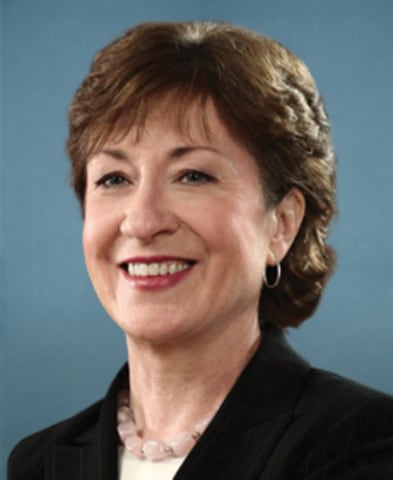
Susan M. Collins
R Republican nominee for U.S. Senate, Maine
Senator since 1997
- On the ballot
- On the general election ballotNov 3, 2026 · Maine US Senate
- Where to vote
- Find your polling place (opens in a new tab) · More ways to vote
- Top priorities
- DEFENSE & NATIONAL SECURITY
- EDUCATION
- ENERGY & THE ENVIRONMENT
- HEALTH CARE
- HOMELAND SECURITY
- In Congress
- Senator since 1997 · votes with their party 84% of the time · chairs Senate Committee on Appropriations. See the record · Office phone 202-224-2523
- Money
- $22.5M raised, $22.4M spent, $2.7M cash on hand (through Oct 14, 2026). Where it comes from
- Who gives
- 17% of individual money from donors at $200 or less · 9.3% from Maine · largest committee giver NRSC, $62K
- Outside groups
- $4.7M supporting, $31M opposing Collins
- Backed by
- Maine Fraternal Order of Police · Pleasant Point Passamaquoddy Tribe. As the campaign lists them
- Polling
- 47% in the latest poll (Marist University) · trails Troy Jackson by 2.7 points on average. The polls
- Sponsored most in
- Health, Education, Commerce
9 priorities from collins.senate.gov, in the order they are listed there. Every heading and the text under it is copied exactly, as one passage for each page it is from, and links to that place on the page; hover a source to see which passage it opens.
As a member of the powerful Senate Appropriations Committee and the Senate Select Committee on Intelligence, I hold key positions in Congress that oversee and shape national security issues of importance to both Maine and the United States. I have successfully secured provisions in annual defense authorization and funding bills that support work at Bath Iron Works, Portsmouth Naval Shipyard, the University of Maine, Saco Defense, Pratt & Whitney, and other companies that are vital to Maine's economy.
source ↗ (opens the page at this passage) · collins.senate.gov/issues/defense-and-national-security
Heading as listed on collins.senate.gov/issues ↗ (opens collins.senate.gov/issues at this heading)
I have a strong record of supporting education at all levels. This includes promoting early childhood education, improving our public school system for kindergarten through 12th grade, and working to increase the affordability of higher education. As a member of the Senate Appropriations Committee and the Senate Education Committee, I will continue to work to ensure that Congress provides robust funding and targeted legislation for the most effective educational programs aimed at helping teachers and students succeed.
I have made engaging with Maine’s students and faculty a top priority, visiting more than 200 schools during my time as a Senator.
source ↗ (opens the page at this passage) · collins.senate.gov/issues/education
Heading as listed on collins.senate.gov/issues ↗ (opens collins.senate.gov/issues at this heading)
From tourism and recreation to working forests, fishing, and agriculture, there is no doubt that Maine’s economy is inextricably linked to the environment. Maine’s greatest treasure is its natural beauty, and I remain committed to advancing reasonable and effective policies to protect the environment.
Throughout my time in the U.S. Senate, I have worked to reduce greenhouse gas emissions and spur the creation of clean energy jobs – while retaining important American manufacturing jobs. High costs of energy are burdensome to Maine families, truck drivers, farmers, fishermen, schools, small businesses, mills, and factories. Approximately 60 percent of Maine households rely on fuel oil as their primary source of home heating, leaving Maine families extremely vulnerable to high crude oil prices.
source ↗ (opens the page at this passage) · collins.senate.gov/issues/energy-and-environment
Heading as listed on collins.senate.gov/issues ↗ (opens collins.senate.gov/issues at this heading)
There is no question that our nation’s health care system requires substantial reform. The status quo of soaring medical and prescription drug costs, struggling families, and health care provider shortages across Maine and the nation is unacceptable. I frequently work with my colleagues on both sides of the aisle to address these and other important issues facing our nation, such as enhancing mental health care, expanding drug treatment programs, supporting America’s caregivers, and improving nutrition programs.
As a native of Northern Maine, I understand the specific challenges that rural communities face to receive medical care. Throughout my time in the Senate, I have consistently supported programs to improve and expand access to the health care system, particularly for citizens living in rural areas.
In 1997, I founded the Senate Diabetes Caucus and have led the effort to more than triple federal funding for diabetes research. As the founder and co-chair of the Congressional Task Force on Alzheimer ’s Disease, I have worked to increase funding for Alzheimer’s research and to strengthen support for family caregivers. I have also championed efforts to lower the cost of prescription drugs and launched the Senate’s first bipartisan investigation into the causes, impacts, and potential solutions to these egregious price increases.
source ↗ (opens the page at this passage) · collins.senate.gov/issues/health-care
Heading as listed on collins.senate.gov/issues ↗ (opens collins.senate.gov/issues at this heading)
As the former Chairman and Ranking Member of the Senate Homeland Security and Governmental Affairs Committee, I have championed efforts to strengthen the capabilities and preparedness of first responders, worked to address the issue of homegrown terrorism, and pushed to enhance our nation’s cybersecurity. Throughout my time in the Senate, I have authored legislation and conducted oversight investigations to ensure accountability and prevent waste, fraud, and abuse across the federal government.
source ↗ (opens the page at this passage) · collins.senate.gov/issues/homeland-security
Heading as listed on collins.senate.gov/issues ↗ (opens collins.senate.gov/issues at this heading)
Mainers are hardworking and resilient. I believe that expanding access to robust workforce training is essential to give people the opportunity to gain the skills they need to secure good-paying jobs and forge promising new career paths. In addition, throughout my Senate service, I have championed policies that support small businesses, the job-creating engines that power our economy. I have also authored and supported legislation to provide tax relief for families and job creators, cut bureaucratic red tape, and promote fair trade policies that allow Maine workers and business to compete on a level playing field in the 21st century economy.
source ↗ (opens the page at this passage) · collins.senate.gov/issues/economy
Heading as listed on collins.senate.gov/issues ↗ (opens collins.senate.gov/issues at this heading)
As a member of the Senate Special Committee on Aging, my priorities include improving retirement security, increasing biomedical research for diseases like Alzheimer’s and diabetes, and combatting scams targeting seniors.
During my tenure as Chairman of the Senate Aging Committee from 2015-2021, I led 74 hearings featuring expert testimony on issues important to older Americans, helping to generate and shape at least 45 new laws authored by members of the Committee to support seniors.
source ↗ (opens the page at this passage) · collins.senate.gov/issues/senior-issues
Heading as listed on collins.senate.gov/issues ↗ (opens collins.senate.gov/issues at this heading)
As a leader of the Senate Transportation Appropriations Subcommittee, improving our nation's infrastructure is one of my top priorities.
I was part of a group of 10 Senators--five Republicans and five Democrats--who authored the Infrastructure Investment and Jobs Act. This landmark law will make the most significant investment in American infrastructure since the establishment of the Interstate Highway System in the 1950s. I also co-wrote the section of the law that will make the largest-ever investment to expand broadband Internet in our nation's history.
source ↗ (opens the page at this passage) · collins.senate.gov/issues/transportation
Heading as listed on collins.senate.gov/issues ↗ (opens collins.senate.gov/issues at this heading)
Millions of Americans wear the honorable title of Veteran, and our great State of Maine has one of the highest percentages of Veterans in the country. As the daughter of a World War II Purple Heart recipient, I learned first-hand of the sacrifice that these heroes and their families make to advance the cause of freedom. I have advocated on behalf of our nation’s Veterans by protecting access to rural health care, holding the Department of Veterans Affairs accountable in the wake of scandal, and expediting the process for disabled veterans to obtain the services they earned.
source ↗ (opens the page at this passage) · collins.senate.gov/issues/veterans
Heading as listed on collins.senate.gov/issues ↗ (opens collins.senate.gov/issues at this heading)