Loading this candidate’s profile from the FEC filings and campaign records.
Where They Stand is a nonpartisan guide to everyone running for Congress: their money, their own words and how incumbents voted. Find your ballot →
Candidates › VA-03 race › 2025–2026
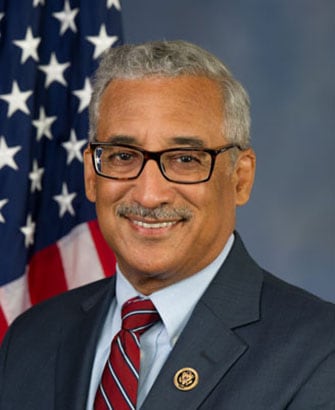
Robert C. "Bobby" Scott
D Democratic nominee for U.S. House, VA-03
Representative since 1993
Other accounts (2)
The same platforms’ other accounts, such as a congressional office’s or an earlier campaign’s.
- On the ballot
- On the general election ballotNov 3, 2026 · Virginia US House 3
- Where to vote
- Find your polling place (opens in a new tab) · More ways to vote
- Top priorities
- PROTECTING OUR ENVIRONMENT AND RESTORING THE CHESAPEAKE BAY
- FIGHTING FOR OUR STUDENTS
- K-12 Education
- Rebuilding America’s Schools
- Making College More Affordable
- In Congress
- Representative since 1993 · votes with their party 99% of the time. See the record · Office phone 202-225-8351
- Money
- $882.2K raised, $886.4K spent, $162.5K cash on hand (through Oct 14, 2026). Where it comes from
- Who gives
- 6.9% of individual money from donors at $200 or less · 77% from Virginia · largest committee giver AMERICAN FEDERATION OF STATE COUNTY & MUNICIPAL EMPLOYEES P E O P L E, $10K
- Outside groups
- $178 supporting Scott
- Sponsored most in
- Labor and Employment, Education, Civil Rights and Liberties, Minority Issues
14 priorities from bobbyscottforcongress.com, in the order they are listed there. Every heading and the text under it is copied exactly, as one passage for each page it is from, and links to that place on the page; hover a source to see which passage it opens.
Bobby has spent his career in public service fighting to protect our environment. In Congress, Bobby serves as co-chair of the Chesapeake Bay Watershed Task Force. Bobby has co-authored with fellow Virginia Congresswoman Elaine Luria the Chesapeake Bay Program Reauthorization Act.
This bill would update and authorize new funding for the federal Chesapeake Bay Program to improve conservation and restoration efforts across the Chesapeake Bay watershed. Bobby has also introduced the Chesapeake Bay Science, Education and Ecosystem Enhancement Act with Maryland Congressman John Sarbanes and Virginia Congressman Rob Wittman to support federal and local efforts to protect the Bay, improve fisheries management, restore watershed habitats, and expand environmental educational opportunities for our students. Bobby has also introduced the Chesapeake Watershed Investments for Landscape Defense (Chesapeake WILD) Act, which would create a new federal grant program to assist local communities to protect and restore wildlife habitats throughout the Chesapeake Bay.
Bobby believes it is critical that the federal government aggressively address climate change. He has supported efforts to restore the United States’ commitment to the Paris Climate Accord, as well as other legislative and regulatory efforts to reduce climate change contributing CO2 emissions, and invest in clean, renewable sources of energy. This is why Bobby is opposed to the Atlantic Coast Pipeline, which would increase and expand the use of CO2 emitting fossil fuels, and cut across protected wilderness and the Appalachian Trail potentially harming these beautiful natural resources for future generations. Bobby is also opposed and has led the fight against oil and natural gas drilling off Virginia’s coast. Bobby believes the potential environmental cost to our shorelines, marine life and ecosystems, and the Chesapeake Bay far outweigh the value of the negligible oil and gas that may be produced from offshore drilling.
source ↗ (opens the page at this passage) · bobbyscottforcongress.com/fighting-for-our-veterans
In January 2019 when Democrats took the majority in the House of Representatives, Bobby was elected chairman of the powerful Education and Labor Committee. As chairman, Bobby is fighting to make sure that all children in America have access to a high-quality public education, regardless of their zip code.
source ↗ (opens the page at this passage) · bobbyscottforcongress.com/fighting-for-schools
In 2015, Bobby was one of the primary authors of the Every Student Succeeds Act (ESSA), which was signed into law by President Barack Obama. ESSA replaced the No Child Left Behind Act and updated the Elementary and Secondary Education Act. Bobby fought to make sure that ESSA upheld the fundamental principles of the landmark Supreme Court decision in Brown v. Board of Education that education is a fundamental “right which must be made available to all on equal terms.” While the Department of Education under Donald Trump has failed to implement the law as intended, Bobby is holding Education Secretary Betsy Devos to account for this administration's failure to uphold its obligation to our students.
In 2016, Bobby worked to commission a Government Accountability Office (GAO) study to review the racial and socioeconomic segregation that still persists in our public schools 65 years after Brown. That report found that America’s schools are more segregated today than they were in the 1960s. Under Bobby’s leadership, the Education and Labor Committee passed two key bills to promote school diversity and protect the civil rights of all students. The Strength in Diversity Act would ensure local communities and school systems have the necessary resources to address racial isolation and concentrated poverty by increasing diversity in our public schools. The Equity and Inclusion Enforcement Act would restore students’ and parents’ rights to directly challenge in court discriminatory public school policies.
source ↗ (opens the page at this passage) · bobbyscottforcongress.com/fighting-for-schools
Too many students are attending school in crumbling facilities that were constructed almost a century ago. Hampton Roads is home to some of the oldest public school facilities in the nation. Local school districts do not always have the necessary resources to renovate existing facilities or build new ones. That is why Bobby introduced the Rebuild America’s Schools Act, which would invest $100 billion in public school renovation and construction and create 1.9 million jobs. Bobby moved his Rebuild America’s Schools Act out of his committee in February 2019. In response to the COVID-19 pandemic, Bobby updated his bill to include resources to assist schools with responding to the pandemic. That bill -- the Reopen and Rebuild America’s Schools Act -- was included in the Moving Forward Act, which passed the House of Representatives in July 2020.
source ↗ (opens the page at this passage) · bobbyscottforcongress.com/fighting-for-schools
Understanding the tremendous burden of financing and getting a college education, Bobby introduced the College Affordability Act. The College Affordability Act is a comprehensive update to the Higher Education Act that will:
- Significantly reduce the cost of college by requiring the federal government and states to invest more in public colleges and universities, increasing the maximum value of the Pell Grant, and making two years of community college free.
- Improve the quality of higher education by going after unscrupulous for-profit colleges, and providing more flexible options and stronger support for individual students’ needs.
- Make student loans more affordable and easier to pay back by simplifying repayment programs, fixing the public service loan forgiveness program, and allowing students to refinance their loans at lower interest rates.
source ↗ (opens the page at this passage) · bobbyscottforcongress.com/fighting-for-schools
Under Bobby’s leadership, the House of Representatives passed a resolution of disapproval to block Betsy DeVos’ Borrower’s Defense Rule that would deny students the ability to discharge their student loans, if they were defrauded by for-profit colleges. Over the last few years, several large for-profit colleges have collapsed and several of these schools delivered false promises to hundreds of thousands of students, in many cases committing out-and-out fraud. Bobby is committed to holding the Trump Administration accountable for denying these students the relief they are entitled to under the law.
source ↗ (opens the page at this passage) · bobbyscottforcongress.com/fighting-for-schools
Virginia is home to several historical black colleges and universities (HBCUs) and the 3rd congressional district is home to Hampton University and Norfolk State University. HBCUs have been critical to providing students of color a quality college education. In September 2019, HBCUs and other minority serving institutions were facing a $255 million shortfall in federal funding that would have cost jobs, important educational programming, and critical financial support for our students. To address this shortfall and preserve this critical federal funding, Bobby helped author the Fostering Undergraduate Talent by Unlocking Resources for Education (FUTURE) Act and expeditiously moved it out of his committee and to the full House of Representatives. Thanks to Bobby’s leadership, the FUTURE Act was signed into law by President Trump in December 2019.
source ↗ (opens the page at this passage) · bobbyscottforcongress.com/fighting-for-schools
Bobby is committed to supporting our seniors and ensuring that they have dignity in retirement.
source ↗ (opens the page at this passage) · bobbyscottforcongress.com/supporting-our-seniors
Millions of Americans rely on private pension plans that they earned through years of hard work. Unfortunately, too many businesses have moved away from defined benefit pension plans. This has left many multi-employer pension plans with fewer contributing participants and, combined with inadequate protections in the law, too many private pension plans are at risk of insolvency in the next few years. Bobby does not believe that retired workers who earned their pensions through their hard work should be left in the lurch or face significant cuts to their benefits. The cost to the federal government and the economy if we did nothing to protect these retirees far outweighs the cost of protecting their hard earned pensions now. That is why Bobby has lead the fight in the House to pass the Butch Lewis Act to strengthen protections for private pension plans and shield retirees, their families, and their communities from the potentially devestating consequences of letting these plans fail. Because of Bobby’s leadership and dedication to retirees, the House of Representatives passed the Butch Lewis Act in July 2019.
source ↗ (opens the page at this passage) · bobbyscottforcongress.com/supporting-our-seniors
Bobby is also fighting back against efforts by Donald Trump and Republicans in Congress to cut Social Security and Medicare to finance tax cuts for big corporations and the super wealthy. Bobby is opposed to any cuts to Social Security and Medicare benefits. That is why he has cosponsored the Social Security 2100 Act, which would increase and improve Social Security benefits by adjusting the annual cost-of-living formula to better reflect the expenses faced by senior citizens. This bill would also ensure that Social Security is available for future generations of Americans.
Bobby has also co-authored the Dignity in Aging Act -- a comprehensive update to the Older Americans Act. This act provides critical funding for our community to ensure seniors have access to food, transportation, and other basic services to ensure that seniors can live independently and with dignity. Under Bobby’s leadership, the Dignity in Aging Act unanimously passed the House of Representatives in October 2019 and is expected to be signed into law soon.
source ↗ (opens the page at this passage) · bobbyscottforcongress.com/supporting-our-seniors
Bobby has spent his entire career fighting for working people and their families.
Raising the Minimum Wage to $15 ↗ (opens bobbyscottforcongress.com/fighting-for-working-people at this heading)
Minimum wage workers have not seen an increase in the federal minimum wage in over a decade. In 2019, Bobby introduced the Raise the Wage Act, which would increase the federal minimum wage to $15 a hour by 2025. Bobby’s bill would deliver a long overdue raise to 33 million American workers and lift 13 million Americans out of poverty, including 600,000 children. Bobby’s Raise the Wage Act passed the House of Representatives in July 2019.
Protecting the Right to Organize ↗ (opens bobbyscottforcongress.com/fighting-for-working-people at this heading)
Bobby understands that America’s labor movement helped build the middle-class and protect workers from unfair labor practices by employers. Unfortunately, over the last several decades the ability of workers to collectively bargain has been eroded by states and the federal government. That’s why Bobby introduced the Protecting the Right to Organize (PRO) Act in 2019. The PRO Act would reform federal labor laws to strengthen workers’ right to organize and form a union and bargain for safer working conditions, higher wages, and better benefits. Bobby’s PRO Act passed the House of Representatives in February 2020.
Protecting Older Workers from Discrimination ↗ (opens bobbyscottforcongress.com/fighting-for-working-people at this heading)
Older workers too regularly face discrimination in the workplace, which has only worsened since the Supreme Court’s 2009 decision in Gross v. FBL Financial Services that weakened key protections in the Age Discrimination in Employment Act (ADEA). Bobby is fighting to protect older workers and introduced the Protecting Older Workers Against Discrimination Act (POWADA). Bobby’s bill would restore and strengthen the protections for older workers that the Supreme Court rolled back in 2009. Bobby’s bill passed the House of Representatives in January 2020.
Ending the Gender Pay Gap ↗ (opens bobbyscottforcongress.com/fighting-for-working-people at this heading)
Even today in 2020 women are still earning, on average, 80 cents for every dollar a man makes. This gender pay gap is even worse for African American and Hispanic women. To address this persistent pay gap, one of the first bill’s Bobby moved out of his committee in February 2019 was the Paycheck Fairness Act, which would strengthen the Equal Pay Act and require employers to prove that pay disparities between men and women are job-related. Thanks to Bobby’s leadership, the Paycheck Fairness Act passed the House of Representatives in March 2019.
Supporting Expectant Mothers in the Workplace ↗ (opens bobbyscottforcongress.com/fighting-for-working-people at this heading)
In addition to the pay gap, women too often face pregnancy discrimination despite the fact that women are increasingly becoming the primary breadwinner for their families. Bobby is working to increase workplace protections for expectant mothers by supporting the Pregnant Workers Fairness Act and has moved this important bill out of the Education and Labor Committee in January 2020.
source ↗ (opens the page at this passage) · bobbyscottforcongress.com/fighting-for-working-people
Bobby worked with President Obama to pass the Affordable Care Act (ACA) in 2010. The ACA helped millions of uninsured Americans gain access to health insurance, many for the first time. Obamacare also ended the practice of private insurance companies from denying insurance to individuals with pre-existing conditions and capping the amount of care an individual can receive.
For the last decade, Bobby has helped lead the fight against Republican attempts to repeal Obamacare. As chairman of the Education and Labor Committee, Bobby is also leading the fight against the Trump Administration's ongoing sabotage of Obamacare.
However, Bobby knows that the ACA was only a step towards improving our nation’s health care system. While Bobby supports Medicare for All and has been a cosponsor since his first term in Congress, he understands that it can’t be done overnight. Bobby supports adding a Medicare-styled public option to Obamacare to give individuals a more affordable choice and help drive down the cost of private insurance. Bobby also supports and has introduced legislation to build upon and improve the Affordable Care Act to limit deductibles, expand the eligibility for Obamacare insurance premium subsidies, further limit out-of-pocket expenses, and extend open enrollment and outreach efforts to ensure more individuals are aware of their insurance options.
In December 2019, Bobby helped author and lead efforts in the House of Representatives to pass the Elijah E. Cummings Lower Drug Costs Now Act. This landmark legislation would lower prescription drug costs for millions of Americans saving them $500 billion over the next decade. These savings would be reinvested to expand Medicare benefits, strengthen community health centers, and support other vital public health programs.
Bobby is also leading the fight to end surprise medical bills. He’s introduced the Ban Surprise Billing Act to protect patients from getting huge, unexpected medical bills through no fault of their own. Surprise bills are having an increasing devastating impact on families. Bobby’s Ban Surprise Billing Act would provide critical consumer protections for patients and would hold patients harmless from paying these exorbitant bills. Bobby moved the Ban Surprise Billing Act out of his committee in February 2020 and is committed to ensuring Congress passes these protections for patients this year.
source ↗ (opens the page at this passage) · bobbyscottforcongress.com/fighting-for-our-students