Loading this candidate’s profile from the FEC filings and campaign records.
Where They Stand is a nonpartisan guide to everyone running for Congress: their money, their own words and how incumbents voted. Find your ballot →
Loading this candidate’s profile from the FEC filings and campaign records.
Where They Stand is a nonpartisan guide to everyone running for Congress: their money, their own words and how incumbents voted. Find your ballot →
Candidates › IL-01 race › 2025–2026
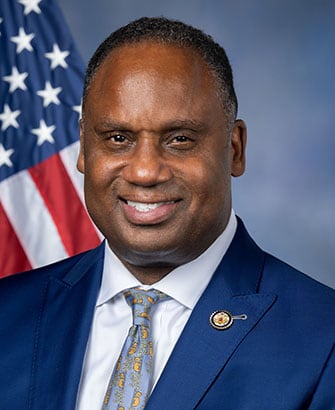
D Democratic nominee for U.S. House, IL-01
Representative since 2023
The same platforms’ other accounts, such as a congressional office’s or an earlier campaign’s.
4 priorities from jacksonforcongress.com, in the order they are listed there. Every heading and the text under it is copied exactly, as one passage for each page it is from, and links to that place on the page; hover a source to see which passage it opens.
Active championing of voting rights aligns with a historic push for electoral fairness, exemplified by key legislative milestones such as the Voting Rights Act of 1965, which sought to eliminate racial discrimination in voting, and more recent efforts like the For the People Act and the John Lewis Voting Rights Advancement Act. Support for these initiatives aims to enhance voter access, counteract suppression, and ensure fair representation. This activism reflects a continued commitment to protecting and expanding voting rights, building on over 70 years of legislative progress and civil rights advocacy.
source ↗ (opens the page at this passage) · jacksonforcongress.com
Heading as listed on jacksonforcongress.com ↗ (opens jacksonforcongress.com at this heading)
Strong advocacy for Medicare for All reflects a broader push for universal health coverage and addressing disparities in the U.S. healthcare system. Since the 1990s, significant strides have been made in healthcare reform, including the introduction of the Affordable Care Act in 2010, which expanded access to insurance and aimed to reduce disparities. The ongoing debate and support for Medicare for All highlight a continued commitment to comprehensive healthcare reform and expanding coverage to all Americans, building on these recent advancements.
source ↗ (opens the page at this passage) · jacksonforcongress.com
Heading as listed on jacksonforcongress.com ↗ (opens jacksonforcongress.com at this heading)
A strong advocate for women's health and reproductive rights, Congressman Jonathan Jackson supports legislation aimed at ensuring comprehensive healthcare access. This advocacy builds on key historical milestones, such as the 1973 Roe v. Wade decision and the Women's Health Protection Act, which he endorses to safeguard reproductive freedoms. His efforts are part of a broader push for gender equality and healthcare access, drawing on progress from the Equal Pay Act of 1963 to contemporary reproductive rights battles. Jackson’s activism is dedicated to protecting and expanding access to women's health services and reproductive care amid ongoing challenges.
source ↗ (opens the page at this passage) · jacksonforcongress.com
Heading as listed on jacksonforcongress.com ↗ (opens jacksonforcongress.com at this heading)
Congressman Jonathan Jackson advocates for equal and adequate education, drawing from his experience as a professor at Chicago State University. His efforts align with key legislation like the Elementary and Secondary Education Act of 1965 and its reauthorization, the Every Student Succeeds Act of 2015. These laws aimed to close achievement gaps and increase support for disadvantaged schools. Jackson’s push includes expanding funding for under-resourced schools and improving early childhood education. His work reflects a continued commitment to educational equity, building on 60 years of progress in addressing systemic disparities in the U.S. education system.
source ↗ (opens the page at this passage) · jacksonforcongress.com
Heading as listed on jacksonforcongress.com ↗ (opens jacksonforcongress.com at this heading)
97% of their votes went with their party’s majority; they broke with it 21 times in the 119th Congress.
House Committee on Agriculture
House Committee on Foreign Affairs
Matching this candidate against the House and Senate voting records…
The CRS policy areas of Jackson’s 15 substantive sponsored measures, Congresses 117, 118, 119; the figure is how many fall in each. Sponsorship indicates legislative focus, not every policy position. GovInfo source ↗
FEC filings, Jan 1, 2025 to Oct 14, 2026 · Official FEC bulk data · committee C00802603
$1.03 has been spent for every dollar raised across 9 reports ($552.7K of $539.1K). Cash on hand went from $31K on Mar 31, 2025 to $40.1K on Oct 14, 2026.
| Report | Raised in the period | Spent in the period | Cash on hand at its close |
|---|---|---|---|
| APRIL QUARTERLY 2025 through Mar 31, 2025 | $49,228 | $71,936 | $30,980 |
| JULY QUARTERLY 2025 through Jun 30, 2025 | $33,884 | $48,935 | $15,930 |
| OCTOBER QUARTERLY 2025 through Sep 30, 2025 | $48,898 | $46,005 | $18,822 |
| YEAR-END 2025 through Dec 31, 2025 | $115,213 | $57,367 | $76,667 |
| PRE-PRIMARY 2026 through Feb 25, 2026 | $64,002 | $45,652 | $95,018 |
| APRIL QUARTERLY 2026 through Mar 31, 2026 | $40,800 | $46,436 | $89,382 |
| JULY QUARTERLY 2026 through Jun 30, 2026 | $66,324 | $108,543 | $47,163 |
| OCTOBER QUARTERLY 2026 through Sep 30, 2026 | $96,348 | $111,027 | $32,484 |
| PRE-GENERAL 2026 through Oct 14, 2026 | $24,353 | $16,768 | $40,070 |
Each report’s own period, as filed with the FEC; a report filed again counts once, as its latest copy.
6 endorsers listed on Jonathan L. Jackson’s own campaign site: 2 unions, 4 organizations.
This is the campaign's claim, checked by an editor against its page; the endorsers have not confirmed it to us. Each name opens the campaign’s page with that name highlighted.
No count published yet · Full results ↗
Election not held yet · Full results ↗
Every contest for this seat that named this candidate, most recent last; a result is shown once the race is called. Election dates and results from civicAPI (civicapi.org). civicAPI aggregates results from Secretaries of State and equivalent election bodies, and makes its own race calls. civicapi.org ↗
Official FEC filing record for the current cycle. The priorities they publish are quoted from their own site, in their order.
Statements are quoted from these pages exactly. Headings, order and wording are the campaign’s; the record marking is ours.
A donor who gave several times appears once. The 12 largest donors by total given are listed. In all, 260 itemized contributions were filed this cycle, totaling $265.8K.
The 12 largest committees by total given are listed. In all, 109 committee contributions were filed this cycle, totaling $215.5K. Counted from the givers' own filings, which can run above the total the campaign itself reports.
Total reported receipts $539,051
Every dollar the committee reported receiving this cycle, split by the source the FEC filing attributes it to. Open a source marked + to see who gave. FEC filings through Oct 14, 2026.
Loading the map
Tap or hover over a state, or focus the map and use the arrow keys, to read its total. Ctrl or ⌘ and scroll to zoom.
39% of the money placed by state came from inside Illinois: $102.1K of $262.6K.
| Name | Amount |
|---|---|
| 125 contributions · 39% | $102,142 |
| 16 contributions · 11% | $28,800 |
| 20 contributions · 9.7% | $25,500 |
| 21 contributions · 9.3% | $24,400 |
| 9 contributions · 7.7% | $20,300 |
| 14 contributions · 6.4% | $16,910 |
| 6 contributions · 5.9% | $15,500 |
| 8 contributions · 5.7% | $15,000 |
By the state each donor wrote on the filing, across 18 states and territories. Donors who have given $200 or less this cycle are not itemized, so they cannot be placed on a map. The FEC’s grouping also counts joint-fundraising memo lines, so these rows can add up to more than the itemized total.
| Employer as filed | Amount |
|---|---|
| Written instead of an employer · 74 contributions · 20% of ranked | $50,291 |
| Written instead of an employer · 21 contributions · 12% of ranked | $31,050 |
| 4 contributions · 5.4% of ranked | $14,000 |
| 5 contributions · 3.1% of ranked | $8,000 |
| 2 contributions · 2.7% of ranked | $7,000 |
| 2 contributions · 2.7% of ranked | $7,000 |
| 2 contributions · 2.7% of ranked | $7,000 |
| 2 contributions · 2.7% of ranked | $7,000 |
A further $8,770 came from donors whose answer names no employer (blank), so it is not ranked. Itemized gifts over $200, grouped by the words donors filed: not an industry classification, and a gift from an employee is not a gift from the employer. The FEC’s grouping also counts joint-fundraising memo lines, so these rows can add up to more than the itemized total. Gifts of $200 or less ($12,665) are not itemized, so no employer or occupation is filed for them.
Money groups spent on their own, not through a campaign. Each ad is filed against the candidate it names, so money attacking an opponent shows on the opponent’s row. Open a candidate to see who spent it.
The campaign also refunded $11,532 in contributions, which the categories below do not include.
Total itemized disbursements $418,619
Every itemized payment the committee reported this cycle, sorted by what it said each one was for. The categories are ours; the wording they are matched against is the committee’s own. Open a category to read the filed descriptions and who was paid. FEC filings through Oct 14, 2026.
All 1,703 itemized payments filed this cycle. Spending below the itemization threshold is not filed line by line.
1 payment was reported as a lump sum, such as a card or payroll bill, with the detail filed underneath as memo entries. Those entries, $2,018 in all, are counted under the payee and purpose they name rather than under the processor that was paid. The total is the same either way.
| Name | Amount |
|---|---|
| 25 payments · 9.3% of all spending | $51,272 |
| 21 payments · 8.6% of all spending | $47,610 |
| 866 payments · 7.1% of all spending | $39,349 |
| 3 payments · 6.5% of all spending | $36,149 |
| 36 payments · 2.3% of all spending | $12,655 |
| 1 payment · 2.3% of all spending | $12,500 |
| 2 payments · 2% of all spending | $11,231 |
| 3 payments · 1.9% of all spending | $10,400 |
The people, firms and committees paid the most, across every kind of payment. Each share is of everything the committee reported spending this cycle, not only the itemized payments above. A payee that is itself a committee links to its own profile.
| Occupation as filed | Amount |
|---|---|
| Written instead of an occupation · 72 contributions · 19% of ranked | $49,741 |
| 11 contributions · 6.4% of ranked | $16,350 |
| 11 contributions · 6.2% of ranked | $16,050 |
| 9 contributions · 5.4% of ranked | $14,000 |
| 7 contributions · 4% of ranked | $10,250 |
| 3 contributions · 3.7% of ranked | $9,500 |
| 5 contributions · 3.1% of ranked | $8,000 |
| 6 contributions · 3% of ranked | $7,750 |
A further $8,770 came from donors whose answer names no occupation (blank), so it is not ranked. Itemized gifts over $200, grouped by the words donors filed: not an industry classification, and a gift from an employee is not a gift from the employer. The FEC’s grouping also counts joint-fundraising memo lines, so these rows can add up to more than the itemized total. Gifts of $200 or less ($12,665) are not itemized, so no employer or occupation is filed for them.