Loading this candidate’s profile from the FEC filings and campaign records.
Where They Stand is a nonpartisan guide to everyone running for Congress: their money, their own words and how incumbents voted. Find your ballot →
Candidates › DE-00 race › 2025–2026
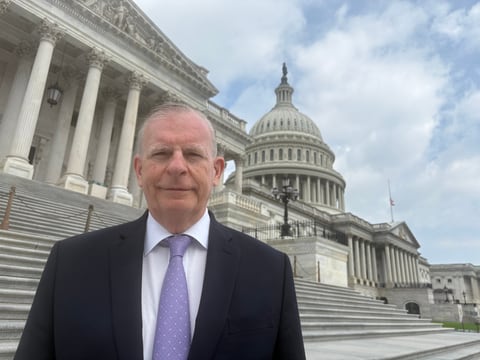
Joseph "Dr. Joe" Arminio
R Republican nominee for U.S. House, DE-00
Has not served in Congress
- On the ballot
- On the general election ballotNov 3, 2026 · Delaware US House At-Large
- Where to vote
- Find your polling place (opens in a new tab) · More ways to vote
- Top priorities
- Seeing the World as It Really Is and Representing Delaware Accordingly
- The American Prosperity Plan
- A Path to Peace and Prosperity Across Eurasia
- Time To "Pivot"
- Money
- $12.3K raised, $5.4K spent, $6.9K cash on hand (through Sep 30, 2026). Where it comes from
- Who gives
- 14% of individual money from donors at $200 or less · 0% from DE
4 priorities from drjoeforcongress.com, in the order they are listed there. Every heading and the text under it is copied exactly, as one passage for each page it is from, and links to that place on the page; hover a source to see which passage it opens.
America, many experts say, is headed toward far worse economic times — but there is an excellent way forward. I champion the American Prosperity Plan, a detailed, verified, comprehensive solution that will restore, if not exceed, 1950s economic growth, get individuals out of debt, boost the debt-free, boost creditors, greatly reduce Uncle Sam's debt and even help stop endless wars.
source ↗ (opens the page at this passage) · drjoeforcongress.com/issues
America is headed toward far worse economic times — perhaps even the worst depression in its history, according to establishment experts. But some of us who draw from unfiltered economic history, and who think for ourselves, see an excellent way forward for all Americans.
I call the detailed reform that I champion the American Prosperity Plan. It will restore, if not exceed, 1950s economic growth. It will get most Americans out of debt entirely, greatly reduce business debts, dramatically boost the debt-free and cut Uncle Sam's debt in about half. Moreover, it tames inflation. As a bonus, it will dramatically reduce our dependence on the ill-fated, war-prone petrodollar system — a system that has, since 1974, tempted America into costly foreign entanglements and undermined the financial security of working families.
The American Prosperity Plan is not a fringe idea. It is the economic reality that Washington refuses to confront — and the bold solution Delaware deserves a champion for in Congress.
source ↗ (opens the page at this passage) · drjoeforcongress.com/issues/issue-1
Eastern Europe and the Middle East are ablaze. America must revive and transform its economy, reduce petrodollar dependence, and be as benevolent a power as possible. I have publicly opposed attacking Iran, even prior to February 28, 2026, and support steering Israel toward the Two-State Solution. Above all, I champion what I call The Grand Bargain in the Middle East and beyond.
source ↗ (opens the page at this passage) · drjoeforcongress.com/issues
Eastern Europe and the Middle East are ablaze. Will Taiwan be caught up in the conflagration? Venezuela is unstable. BRICS, led by Communist China, has surpassed the US-led petrodollar system by some measures.
To navigate these turbulent times, America needs to revive — and transform — its economy. This is among the reasons why I stand for the American Prosperity Plan. This plan also reduces our dependence on the petrodollar system, which, in play since 1974, has tempted us into endless wars, including in Iraq, Iran, and Venezuela.
Most important of all, America needs to be as benevolent a power as it can be. Nowhere does America need to adjust its foreign policy more than in the Middle East. I am for steering Israel toward the Two-State Solution. I have publicly opposed the Iran War, even prior to February 28, 2026. Let us revert to containing, better yet, rolling back financially, the Iranian revolutionaries while peaceably supporting the Iranian people as a whole — who are by nature and history our friends and protective of Jews and Christians.
To stop "endless wars" and to bring about a lasting peace among nations, it makes sense to me that America pursue what I call The Grand Bargain.
source ↗ (opens the page at this passage) · drjoeforcongress.com/issues/issue-2
Before 1903, American schools produced well-rounded, independent thinkers. I stand for teaching critical thinking and unfiltered economic history — including mandating formal debate for grades 9–12, drawing from primary sources and harvesting the full spectrum of perspectives.
source ↗ (opens the page at this passage) · drjoeforcongress.com/issues
A Well-Rounded Citizen Should Be the Goal ↗ (opens drjoeforcongress.com/issues/issue-3 at this heading)
Prior to 1903, American schools produced well-rounded individuals. Graduates were inclined to think for themselves and were ready to contribute to the economy. The General Education Board, which the federal government chartered in 1903, opened the door to the rotting of our public schools.
source ↗ (opens the page at this passage) · drjoeforcongress.com/issues/issue-3
Those who enter Congress take a solemn oath to uphold the Constitution. If elected, I will take that oath seriously — no matter whom I offend. I will uphold the Second Amendment and every other provision, without exception.
source ↗ (opens the page at this passage) · drjoeforcongress.com/issues
Those who enter Congress take a solemn oath to uphold the United States Constitution. If elected to Congress, I will take this oath seriously — so help me God.
Furthermore, I don't care whom I offend if upholding the Constitution is at stake. It goes without saying that, among many things, I will uphold the Second Amendment and promote election integrity. I will read every bill. I will ask whether it is constitutional before I ask whether it is popular. And I will vote accordingly — even when it is politically inconvenient. Delaware deserves a congressman who treats the Constitution as the supreme law of the land, not a document to be worked around.
Speaking of election integrity, the Save America Act is fine, as far as it goes. But it hardly goes far enough. Votes should be cast in person on election day, except in extenuating circumstances, such as the voter is ill or deployed overseas. Proper, physical documentation - including photo ID - should be required to vote. Also, physical, paper ballots should be cast; fully verifiable counting of the vote is essential. We dare not trust in electronic voting.
source ↗ (opens the page at this passage) · drjoeforcongress.com/issues/issue-4
I agree with President Trump: end sanctuary cities and enforce the law. But enforcement requires funding — and funding requires a thriving economy. That is why the American Prosperity Plan is the foundation of a serious immigration policy.
source ↗ (opens the page at this passage) · drjoeforcongress.com/issues
During his State of the Union Address of February 24, 2026, President Trump said this to Congress: "…end deadly sanctuary cities that protect the criminals and enact serious penalties for public officials who block the removal of criminal aliens." I am in complete agreement with this position.
But why has the President's immigration policy not been completed and not gone smoothly? A large part of the reason is surely financial. America is short the money to deploy the necessary immigration enforcement.
Toward the end of being able to afford the necessary immigration services and enforcement, I stand for growing our economy dramatically — which, in turn, leads me to champion the American Prosperity Plan. A strong economy is not just good for workers and families. It is the financial foundation that makes serious, humane, and effective immigration enforcement possible.
source ↗ (opens the page at this passage) · drjoeforcongress.com/issues/issue-5
Heading as listed on drjoeforcongress.com ↗ (opens drjoeforcongress.com at this heading)
Four key elements that promise to exceed 1950s economic growth and reduce interest payments on the national debt by more than 50%.
America's Economic Reality ↗ (opens drjoeforcongress.com/american-prosperity-plan at this heading)
No net change since 2008!
136% of GDP!
Private debt on eve of 1929 crash: 90% of GDP
Private debt in 1930: 130% of GDP ↗ (opens drjoeforcongress.com/american-prosperity-plan at this heading)
After deleveraging, private debt in 1950: 50% of GDP
America's Economic Reality Revealed In Two Charts ↗ (opens drjoeforcongress.com/american-prosperity-plan at this heading)
Private and public debts as percent of GDP
This chart shows that PRIVATE DEBT is a far, far greater problem than PUBLIC DEBT has ever been. To be exact, this chart tracks two ratios side by side across nearly two centuries: private debt (individuals and businesses combined, marked with triangles) and public debt (the federal government's debt, marked with diamonds), both expressed as a percentage of GDP. Three vertical markers flag pivotal moments — the Depression of 1840, the Great Depression, and the 2008 Global Financial Crisis.
Further clarification of this chart is in order. Private debt triggered all three economic calamities — in 1840, 1929 and 2008. In 1840, private debt soared to 50% of GDP, whereas public debt was nearly zero. In 1929–32, private debt soared to 132% of GDP, whereas public debt was around 15% (a non-factor). In 2008, private debt spiked to 158% of GDP, whereas public debt, sitting at 40% of GDP, was a non-factor. By law, public spending increased after the crisis began, rising initially to 80% of GDP.
How disastrous that private debt as a share of GDP has remained even higher than at any point during the Great Depression! Today, private debt is 136% of GDP, whereas its high during the Great Depression was 132%. The Great Depression did eventually end: private debt "deleveraged" the hard way (depression and world war) by 1950. Private debt has NOT "deleveraged" today! America — Main Street America, that is — is stuck with too much private debt. Private-sector aggregate demand is abysmal. The real (productive side) of the economy cannot grow. Hence, the urgent need for my proposed AMERICAN PROSPERITY PLAN.
Real gross domestic product trend, 1930–2025
This chart shows how our representatives in Washington, D.C. have allowed the economy to be driven into the ground!
The economy was in a good place in 1950. But private debt was allowed to build up relentlessly until 2008. The primary blame falls on Wall Street and its cronies in the Federal Reserve. In 1951, Wall Street lobbied the federal government to enact "Fed Independence." They got their wish in that same year. Deregulation of the banks proceeded apace. They rigged the system, in part offering far too easy credit and assuring us that all was well. A marked shift from productivity to speculation began. By 2008, it was, in a sense, 1929 all over again.
It's good when Wall Street does well, but Main Street should receive a fair shake, too.
Reducing Private Debt ↗ (opens drjoeforcongress.com/american-prosperity-plan at this heading)
Private debt is a far greater problem than even Public Debt. (Private debt has triggered virtually all financial crises, including the 1929 crash and Global Financial Crisis of 2008-9.) It holds back individuals, families and businesses, and has led to a stagnant economy since 2008. The average American's private debt is $72,200. (Total household debt - about $19 trillion - divided by total population 21 years of age or older equals $72,200.) There is only one responsible way to deleverage now — a Debt Jubilee that makes both debtors and creditors whole, and treats the debt-free equally, all without inflation.
Reducing Domestic Holdings of Public Debt and Eliminating Intragovernment Debt ↗ (opens drjoeforcongress.com/american-prosperity-plan at this heading)
Domestic holdings of U.S. national debt amounts to $21.91 trillion. Intragovernment debt, including Social Security, amounts to $7.65 trillion. It's time for the Treasury Department to emit "Greenbacks," of the type that the GOP-led Civil War Congress and Lincoln Administration emitted to help win the war. This will reduce domestic holdings of national debt to $13.96 trillion in 5 years and will eliminate Intragovernment debt in 20 years.
Reducing Foreign Holdings of Public Debt ↗ (opens drjoeforcongress.com/american-prosperity-plan at this heading)
Foreigners hold $9.35 trillion of US national debt. It's time to levy a financial transaction tax on the trade of US stocks, as was done from 1914 to 1966. Consequently, foreign holdings of US debt can be reduced by 80% in 30 years.
Yet Another Incredible Boost to the Entire Economy ↗ (opens drjoeforcongress.com/american-prosperity-plan at this heading)
The American Society of Civil Engineers has identified about $3.7 trillion of needed infrastructure funding. The National Low Income Housing Coalition estimates an affordable housing shortfall of about $1.67 trillion. The proposed AIB, which the Treasury Department would manage, could lend most of the needed funding at submarket rates without raising taxes and with borrowing. Better yet, the Treasury would make a profit. 25 million high paying jobs would result and real GDP would grow about 3%.
Historical Context
Aristotle ↗ (opens drjoeforcongress.com/american-prosperity-plan at this heading)
America's Founding Fathers devoured the works of Aristotle, who lived from 384 to 322 B.C. Aristotle argued that money is what the sovereign say it is. Surely, he would have applauded the Lincoln Administration's emission of Greenbacks and would say to the federal government today - "Absolutely, emit Greenbacks again!" (See the Home page for more about Aristotle.)
"Regarding the Great Depression … we [the Federal Reserve] did it [caused the Great Depression]. We're very sorry. … we won't do it again."
Bernanke meant that the Fed let down Main Street and a great many banks, too, in the 1930s. In response to the Global Financial Crisis of 2008-09, Bernanke, then Fed Chairman, bailed out the superrich and big banks. But he and his fellow Fed Board members forgot about Main Street! 18 years later, Main Street is still hurting. Private debt is too big. It's time to "deleverage" private debt, revive private-sector aggregate demand and rekindle the economy. It's time for Dr. Joe's American Prosperity Plan!
The American Prosperity Plan is putting a Debt Jubilee front and center. Let us combine bold economic reform, wide-ranging study groups, and the incredible diversity of American insight into a new launch of the American Dream.
source ↗ (opens the page at this passage) · drjoeforcongress.com/american-prosperity-plan
The only responsible path to deleveraging private debt — making both debtors and creditors whole, and benefitting the debt-free, as well, all without inflation.
For 18 years, private debt as a share of GDP has been even higher than at any time during the Great Depression — holding back individuals, families, businesses and the entire economy.
Private debt (what individuals, families and businesses owe to banks) is a far greater problem than even Public Debt. It holds back individuals, families and businesses; it has led to a stagnant economy since 2008, because private aggregate demand of people and businesses is very low. For 18 years, private debt as a share of GDP is even higher than at any time during the Great Depression!
🏠Youth cannot afford to buy property or marry.
🛒Families struggle to buy even groceries.
🏢Businesses cannot get started or expand.
🏥Hospital bills sink a person's prospects.
There are many reasons for this high debt but the biggest factor is the very nature of our financial system (and nearly all past and present systems), which invariably eventually leads to crushing private debt. Depression and world war led to the deleveraging (big reduction) of private debt by 1950. Healthy and strong aggregate demand returned. The US economy took off.
The history of financial crises since 1819 (see Recommended Reading below) shows that, absent depression or massive war or both, there is only one way we can responsibly and relatively easily deleverage now — institute a debt jubilee in such a way that (a) both debtors and creditors are made whole, (b) the debt-free are treated equally and (c) inflation does not result. I am campaigning for a debt jubilee of this very type.
Learn how it starts with every adult receiving $92,400, debts dramatically reduced across the economy, wages rising and economic growth of the 1950s level returning.
It's not magic. It's an adjustment to the banking system that economists indicate can be undertaken right now but not again for a very long time.
Summary
Debt Jubilee in a Nutshell ↗ (opens drjoeforcongress.com/ami/debt-jubilee at this heading)
The proposed Debt Jubilee is not inflationary; moreover, it immensely benefits debtors, creditors and the debt-free alike. It is not inflationary because, for one thing, the elimination of debt does not increase the money supply a single penny. $92,400 goes out to every adult 21 years of age or older, regardless of financial circumstances. This amount must be used immediately to reduce private debt, which means that each tranche of $92,400 disappears along with the retirement of the corresponding debt.
The Jubilee immensely benefits Main Street and the "real economy" because it frees up individuals and businesses as they have not been in decades. Banks (creditors) are better off, too — they receive government-backed "Jubilee Bonds" in place of far more risky private-sector financing. And the debt-free are rewarded, increasing their wealth, too. The net effect is extraordinary: real economic growth takes off, government revenues increase, and the taxpayers' overall burden diminishes.
Some call this proposal a Modern Debt Jubilee. Versions of it were practiced in ancient times. Several governors of the newly independent 13 American states, from 1781 to 1788, apparently practiced something like it, too. Also, debt forgiveness or restructuring, which is but one component of the proposed Jubilee, has been commonplace between banks and borrowers throughout history.
Five Stories: How It Works ↗ (opens drjoeforcongress.com/ami/debt-jubilee at this heading)
See the Debt Jubilee in action through five real-world scenarios — a family mired in debt, a debt-free retiree, a struggling business, a nervous bank, and the U.S. taxpayer.
source ↗ (opens the page at this passage) · drjoeforcongress.com/ami/debt-jubilee
← Back to American Prosperity PlanElement 02 — American Prosperity Plan ↗ (opens drjoeforcongress.com/ami/emitting-greenbacks at this heading)
Treasury-issued, debt-free, interest-free money to eliminate intragovernment debt and dramatically reduce domestic holdings of public debt — the kind of money that Lincoln's GOP-led Congress approved during the Civil War.
Two Objectives
Reduce Intragovernment Debt to Zero ↗ (opens drjoeforcongress.com/ami/emitting-greenbacks at this heading)
Over 20 years
Intragovernment debt — including Social Security obligations — currently stands at $7.65 trillion. The Treasury Department will emit Greenbacks amounting to 5% of the present intragovernment debt per year for 20 years, steadily retiring this obligation without raising taxes or borrowing from private banks.
Reduce Domestic Holdings of Public Debt ↗ (opens drjoeforcongress.com/ami/emitting-greenbacks at this heading)
From $21.91 trillion to $13.96 trillion in 5 years
The Treasury Department will emit Greenbacks amounting to 5% of GDP for 5 consecutive years. This targeted emission reduces the domestically held portion of the national debt by $7.95 trillion — with little or no inflation (see Recommended Reading below), without new borrowing, and without burdening taxpayers.
Background
What Are Greenbacks? ↗ (opens drjoeforcongress.com/ami/emitting-greenbacks at this heading)
Greenbacks are debt-free, noninterest money issued directly by the Treasury Department. They are not Federal Reserve Notes — which are debt-based and pay interest to large private banks. The GOP-led Civil War Congress voted for and President Lincoln signed into law the emission of Greenbacks to finance the Union war effort without borrowing from private banks. This is a proven, constitutional tool that has been used before in American history. Moreover, versions of Greenbacks were instrumental in winning the American Revolution and sustaining the prosperity of colonial America.
Key Distinction ↗ (opens drjoeforcongress.com/ami/emitting-greenbacks at this heading)
Greenbacks are not Federal Reserve Notes. Federal Reserve Notes are debt-based and pay interest to big private banks. Greenbacks are debt-free and noninterest — the government creates them directly, without borrowing.
To understand the ins and outs of Greenbacks, I recommend the discussion toward the bottom of the following article:
Caveat: Richard Vague correctly points out that it is important to monitor the emission of Greenbacks for inflation. Just as too many Federal Reserve Notes can cause inflation, too many Greenbacks can cause inflation. The Treasury Department should be prepared to slow down Greenback emission, if need be. Even so, America's long experience with the emission of Greenbacks and similar currencies, including during the years 1862 to 1879, very strongly suggests that the Greenback element of the proposed American Prosperity Plan is sound.
source ↗ (opens the page at this passage) · drjoeforcongress.com/ami/emitting-greenbacks
← Back to American Prosperity PlanElement 03 — American Prosperity Plan ↗ (opens drjoeforcongress.com/ami/financial-transaction-tax at this heading)
A modest levy on stock trades — as the U.S. used from 1916 to 1966 — to eliminate foreign holdings of the national debt within 20 years.
Reduce Foreign Holdings of Public Debt by 80% ↗ (opens drjoeforcongress.com/ami/financial-transaction-tax at this heading)
Over 30 years
Foreign nations currently hold $9.35 trillion of U.S. public debt — a significant source of economic and geopolitical leverage over the United States. The Financial Transaction Tax provides a dedicated, proven revenue stream to retire this obligation nearly completely within 30 years, helping restore American financial sovereignty.
The Mechanism
How It Works ↗ (opens drjoeforcongress.com/ami/financial-transaction-tax at this heading)
The tax levies no more than 0.5% of the total annual value of stock (roughly $50 trillion) traded on U.S. exchanges. This is a minimal rate — far below the bid-ask spreads that have existed for more than a century — and falls primarily on high-frequency and speculative trading rather than on ordinary long-term investors.
Historical Record
1916–1966 ↗ (opens drjoeforcongress.com/ami/financial-transaction-tax at this heading)
Historical rate range
This is not a new idea. From 1916 to 1966, the United States government levied a financial transaction tax of between 0.2% and 0.4% on stock trades. The tax coexisted with the strongest period of broad-based economic growth in American history. It was repealed not because it failed, but because of lobbying pressure from Wall Street. Dr. Joe's proposal restores a proven tool — at a rate no higher than 0.5% — to serve the public interest once again.
source ↗ (opens the page at this passage) · drjoeforcongress.com/ami/financial-transaction-tax
In order to stop, once and for all, "endless wars," it is necessary to strike a Grand Bargain across Eurasia and to restore high economic growth, without heavy reliance upon the petrodollar. The United States must initiate and oversee this Grand Bargain and should implement my American Prosperity Plan or a facsimile thereof. The prosperity plan is discussed in depth elsewhere on this site. What follows focuses upon the proposed Grand Bargain.
Benevolence is a crucial ingredient in achieving a worthwhile peace. Thus, the very first thing to do is to end the Iran War right now. That done, the rollout of The Grand Bargain can begin. America must require that Israel irreversibly implement the "Two-State" solution according to a relatively short timetable and that the Sunni Arab States, especially Egypt, Jordan and Saudi Arabia, normalize relations with Israel according to a corresponding schedule.
Israel suffers from an acute lack of strategic depth; to live side by side with an essentially sovereign Palestinian state is risky for the Israelis. Israel and the Sunni Arabs are fearful of the Iranian Revolutionary Guard Corps (IRGC) and its proxies. Thus, the US, Israel and Sunni Arabs should form a Middle East Air Defense system and the Sunni Arabs should take the lead in preventing the buildup of a Palestinian offensive military capability.
Two massive education efforts are in order. The American public must be apprised of the true history of Persia and then Iran from the time of Cyrus the Great down to today. It must be shown how the Iranian people as a whole have been the protectors of the Jews and Christians and how they have sought good relations with the West. At the same time, the Iranian people as a whole must be shown that a magnificent economic future awaits them in the form of an emerging India-Middle East-Europe (IMEE) economic corridor.
The IRGC must be given a choice. Either reenter the comity of nations or face isolation. They can choose either the easy way or the hard way. The IRGC is a state within a state. Just as the Israelis should be required to abandon their pursuit of a Greater Israel, so too should the IRGC be required to abandon any designs to destroy Israel. Like Iran as a whole, the IRGC should be invited to participate in the new IMEE corridor, but only as a cooperative participant. If the IRGC refuses to cooperate, then it should be militarily contained and surgically sanctioned. It is vital not to sanction Iran as a whole. Rather, the great mass of Iranians should be assisted by every means, short of the use of force, to reclaim control of Iran.
Russia, Communist China and the IRGC have forged a deadly alliance. On top of that, China's GDP, adjusted for inflation, appears to be 1 3/4s larger than America's. Russia must be wooed toward the West. This necessitates forcing Ukraine to make major concessions to Russia. Above all, NATO must agree to cease expansion eastward of Poland. Russia, for its part, must renounce the goal of conquering the core of Ukraine. Economic incentives should be offered to Russia in return for disengaging from the war on Ukraine and from the IRGC.
The rollout of the IMEE will go a long way toward countering the expansion of Beijing's Belt and Road Initiative. The ultimate counterweight to an authoritarian China must be a revived American economy and an enduring, prosperous, morally upright America-led global alliance. The proposed American Prosperity Plan will enable the United States to exceed the projected growth of the Chinese. Also, it will be important to maintain America's lead in innovation and in being the most attractive economy for foreign investment.
Since 2004, Beijing has insisted that its overall policy is "Peaceful Rise." America needs to hold Beijing to this, while carefully integrating them into the world economy.
If America will renew its republic and economy, including responsibly harnessing Ai, then it will surely be able to stand up to the Communists of China, until true democracy spreads from Taiwan into the heart of the mainland. Thereafter, America, China and mankind as a whole will taste the full fruits of the Grand Bargain.
source ↗ (opens the page at this passage) · drjoeforcongress.com/issues/grand-bargain
I pledge to enter Congress with hundreds of concerned citizens in formal support, utilizing dozens of citizen study groups drawing from every point of view. Together, we will combine the American Prosperity Plan, The Grand Bargain and the incredible diversity of American insight into a new launch of the American Dream.
source ↗ (opens the page at this passage) · drjoeforcongress.com/issues