Loading this candidate’s profile from the FEC filings and campaign records.
Where They Stand is a nonpartisan guide to everyone running for Congress: their money, their own words and how incumbents voted. Find your ballot →
Candidates › CA-17 race › 2025–2026
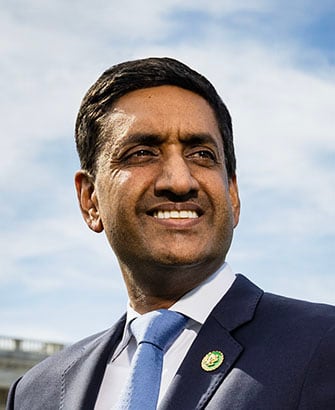
Ro Khanna
D Democratic nominee for U.S. House, CA-17
Representative since 2017
Other accounts (1)
The same platforms’ other accounts, such as a congressional office’s or an earlier campaign’s.
- On the ballot
- On the general election ballotNov 3, 2026 · California US House 17
- Where to vote
- Find your polling place (opens in a new tab) · More ways to vote
- Top priorities
- Marshall Plan for America
- Lower Costs
- Humans Over AI
- Stop Wars and Genocide
- Medicare for All
- In Congress
- Representative since 2017 · votes with their party 97% of the time. See the record · Office phone 202-225-2631
- Money
- $15.3M raised, $9.5M spent, $16.6M cash on hand (through Oct 14, 2026). Where it comes from
- Who gives
- 13% of individual money from donors at $200 or less · 59% from California · largest committee giver LABORERS' INTERNATIONAL UNION OF NORTH AMERICA (LIUNA) PAC, $5K
- Outside groups
- $416 supporting, $37.5K opposing Khanna
- Sponsored most in
- Armed Forces and National Security, Taxation, International Affairs
18 priorities from rokhanna.com, in the order they are listed there. Every heading and the text under it is copied exactly, as one passage for each page it is from, and links to that place on the page; hover a source to see which passage it opens.
After WWII, economies all across Europe were devastated. America stepped in to help with the Marshall plan for Western Europe – a massive economic development program including grants, loans, and technical assistance that led to one of the most successful recoveries in history.
Now is the moment for a Marshall plan focused on America. Decades of offshoring, lopsided trade, union busting, and corporate greed has devastated communities across America. By employing the principles of the Marshall plan, America can rebuild. This time not for our allies, but right here at home.
Rebuilding at this scale requires more than individual programs or scattered investments. It requires a national strategy and an institution responsible for driving it.
The next President should establish a National Economic Development Council. America’s economists have traditionally focused on maximizing consumer welfare and profits. But today we also need to focus on creating good jobs, not just in strategic industries but also in the care economy.
The Council is similar to President Johnson’s Office of Economic Opportunity (OEO) that delivered results for job creation, education, and community development in the South. The White House Economic Development Council will focus on the nation.
The National Economic Development Council will work with local leaders to invest in factories, schools, healthcare centers, colleges, housing and projects that revitalize communities that have been hollowed out and that face economic stagnation. This will create good jobs.
The Council will partner directly with mayors, county commissioners, and grassroots leaders to ensure that dollars actually reach the street level and address community needs. It will focus on measurable results and fast project implementation. It would not simply provide capital or make government purchases but will set clear benchmarks for implementation.
The Council will also simplify approval processes with a FastPass for important projects and make government procurement more competitive.
source ↗ (opens the page at this passage) · rokhanna.com/en/platform
Heading as listed on rokhanna.com/en/platform ↗ (opens rokhanna.com/en/platform at this heading)
We need a plan to make America the manufacturing leader of the world. By 2030, Ro wants to build 100 modern factories in small towns and cities to revitalize communities left out by deindustrialization.
National Industrial Bank
- Create a new federally run bank with a simple mission: invest in American industry and jobs. The bank would focus on places where a factory has closed or is at risk of closing. It would finance new projects to replace lost jobs after closures, and it would offer loans to keep factories open when the business is sound but private financing is not available due to a market failure.
- The bank would provide loans, grants, and technical assistance to help communities keep and rebuild good manufacturing jobs and reduce U.S. reliance on China.
- Ensure the bank prioritizes critical emerging technologies, making sure they can be manufactured at scale in the United States, and designed to de-risk private investment.
- It should invest alongside private capital to provide a market check and be governed by an independent board not subject to political cycles to prevent cronyism.
Strategic Industries the Bank Will Support
- CHIPS: Ro’s CHIPS and Science Act invested $120 billion in semiconductor manufacturing, creating over 60,000 jobs and lowering prices. The bill began as the bipartisan Endless Frontier Act introduced by Ro and Rep. Mike Gallagher.
- SHIPS: China built 1,794 ships in 2022. The U.S. built just 5. Ro supports the SHIPS for America Act to rebuild American shipbuilding and expand the manufacturing workforce.
- STEEL: Ro’s Modern Steel Act would build next generation steel plants in deindustrialized towns, strengthen domestic manufacturing, and create good paying jobs.
- BIOTECH: Ro introduced legislation to bring biotech manufacturing back to the U.S., invest in innovation, and reduce reliance on foreign supply chains for critical medicines. He serves on the bipartisan National Security Commission on Emerging Biotechnology.
- ROBOTICS: Ro supports major federal investment in robotics research, development, and deployment to ensure we stay ahead of China.
- RARE EARTH AND CRITICAL MINERALS: As Ranking Member on the House Select Committee on the Chinese Communist Party, Ro is focused on strengthening U.S. supply chains for rare earth and critical minerals essential to clean energy, semiconductors, and defense. He supports expanding domestic mining, processing, and recycling to reduce reliance on China and strengthen American industry.
- PHARMACEUTICALS: Ro supports rebuilding domestic manufacturing of essential medicines, including Key Starting Materials (KSMs) and Active Pharmaceutical Ingredients (APIs), with a focus on generic drugs. He backs targeted federal investment and incentives to reshore production, strengthen supply chain resilience, and ensure affordable access to critical medications.
Keeping Factories in America: Tax Offshoring and Oppose Unfair Trade
- Ro would put American workers first with buy American incentives, penalties for offshoring, fairer taxes, reform H1B abuses, and strong action on unfair Chinese trade practices.
- Focus on America: Ro has a bill to give citizens $5,000 refund for buying U.S. made products.
- Implement a tax on companies that move factories offshore for the community harm, and worker harm. If corporations choose to leave America for more profit, destroying the places and people who built their success, there should be a penalty. The National Industrial Bank should provide financing to plans in economic jeopardy to prevent closures.
- Ro supports targeted tax credits to encourage companies to invest in American factories and hire American workers, because rebuilding our industrial base requires real incentives for production.
- Close the loophole that incentivizes American companies to move jobs overseas. Raise the foreign tax rate to 21% from 10.5%.
- End H1B visa abuse by making sure they are paid a high wage, are not exploited for entry level positions, and never replace an American worker.
- Address unfair Chinese trade practices
- Ro is the ranking member on a special Congressional committee focused on U.S.–China competition and is working to address these unfair trade practices and the trade imbalance between the U.S. and China.
- He supports targeted tariffs to protect critical industries against dumping and unfair competition.
source ↗ (opens the page at this passage) · rokhanna.com/en/platform
Heading as listed on rokhanna.com/en/platform ↗ (opens rokhanna.com/en/platform at this heading)
Over 40 percent of college grads end up in jobs that don’t need a degree. We need a trade school in every community.
- Create or expand 1,000 trade schools nationwide, with the funding to train 100,000 workers each year for high demand careers.
- That includes next generation tech pathways like drone certification, robotics technician, AI prompt engineer, surgical technician, and 3D animation, alongside core skilled trades like welding, mechanics, carpentry, plumbing, and electrician training. Middle Bucks Institute of Technology in Bucks County, Pennsylvania, where Ro grew up, is a national model, with strong enrollment growth in programs such as welding, advanced manufacturing, cosmetology, patient care technician, plumbing, and electrician training.
- Triple the $1.4 billion current Perkins investment to $5 billion a year. This is federal money given to states to support career and technical education programs.
- Invest in advanced certificates and customized training for jobs in healthcare, caregiving, education, retail, marketing, and food delivery that make these service jobs pay more and allow folks to get high paying service jobs.
- Make it free for adults to get a credential at their community college in any field that leads to better job prospects. Many workers want to get a credential to upgrade their skills and increase their pay.
- Encourage the hiring of young people for apprenticeships by giving tax credits to employers who give them a shot.
- Incentivize firms to train workers and create upward mobility from an apprenticeship and training tax credit.
- Establish partnerships between schools and local employers, unions, and manufacturers so training aligns with real job opportunities and leads directly to good-paying jobs.
source ↗ (opens the page at this passage) · rokhanna.com/en/platform
Heading as listed on rokhanna.com/en/platform ↗ (opens rokhanna.com/en/platform at this heading)
As part of a Marshall Plan for America, we should invest in the people who care for our communities. From childcare to eldercare to healthcare, we need major local investment to sustain and create good paying care jobs.
- Create a new federal grant program that sends funding directly to local communities to expand jobs in healthcare, childcare, homecare, and mental health and counseling services.
- Provide grants to community health centers, public schools, community colleges, and local nonprofits so they can hire and prepare workers for care economy jobs.
- Support partnerships between hospitals, childcare providers, senior care facilities, and community colleges to create clear career pathways into nursing, medical assisting, early childhood education, home health care, and eldercare.
source ↗ (opens the page at this passage) · rokhanna.com/en/platform
Heading as listed on rokhanna.com/en/platform ↗ (opens rokhanna.com/en/platform at this heading)
Ro represents Silicon Valley in Congress and his core belief is that Silicon Valley should be in service of America, not America in the service of Silicon Valley. He wants to bring high-paying te ch jobs to every corner of the country to close the racial wealth gap.
- Scale tech programs nationwide that Ro helped establish by partnering with 1,000 community colleges and high schools across the country. These programs consist of an 18 month training course for students with a certificate and a $5,000 stipend and lead to 6 figure jobs at the end.
- Ro has created jobs and programs in over a dozen states from Michigan to Iowa to Pennsylvania. In total, Ro has created thousands of high paying tech jobs for people at leading companies like Google, Microsoft and Zoom that they can do from their own home.
- Scale tech programs with 100 HBCUs to train students and help them land six-figure jobs after graduation.
- Silicon Valley Tech Summit: Ro hosted the first ever Silicon Valley HBCU tech summit at Claflin University in South Carolina. The summit connected top HBCU presidents with leaders from OpenAI, Apple, Google, Microsoft, Dell, and NVIDIA to announce available scholarships, job opportunities, and financial support to HBCU students. Public-Private partnerships with the universities were also discussed.
- HBCU TechWise Program: Ro established an 18-month program with a $5,000 dollar stipend run by Google to empower students from underrepresented groups at Benedict College, an HBCU in Columbia, SC, to get ready for high-growth tech careers at Google and other companies. This program is now available to all 8 HBCUs in South Carolina.
- Jackson State University TechWise Program: Ro established an 18-month program with a $5,000 dollar stipend run by Google at Jackson State University, a public historically black research university. The goal of the program is to empower students from underrepresented groups to get ready for high-growth tech careers at Google and other companies.
- $1.2 million partnership between Zoom and Claflin: In collaboration with Rep. Clyburn, Zoom, and Claflin University, Ro established a partnership for $1.2 million in educational and financial investments, paid apprenticeships year-round, and merit and need based scholarships.
- $20/hour summer apprenticeships: Ro set up a partnership between Charles Schwab Corporation and majority Black university, York College, to give students summer apprenticeships paying $20 per hour working at a billion dollar financial services firm and increase diversity in the financial sector.
- Paid apprenticeship program: Ro coordinated a partnership between Claflin and Silicon Valley tech company Whiterabbit.ai to grant paid apprenticeships to students and established permanent connection between Whiterabbit and Claflin leading to Whiterabbit serving on Claflin Board as a tech advisor, creating a pipeline between Claflin students and tech jobs.
- Scale tech programs with 100 Hispanic Serving Institutions (HSIs) to train students and help them land six-figure jobs after graduation.
- University of Nevada, Reno TechWise Program: Ro worked with Google, former Governor Brian Sandoval, and the University of Nevada, Reno, a Hispanic Serving Institution, to establish an 18-month program with a $5,000 dollar stipend run by Google to empower students from underrepresented groups to get ready for high-growth tech careers at Google and other companies.
- Expand digital resources, education, and job opportunities to rural underserved communities, ensuring they benefit from the 21st-century tech revolution.
- Appalachia Tech Training Program: To bridge the gap between Silicon Valley and rural America, Ro partnered with Republican Rep. Hal Rogers to secure $2.75 million for tech training in Eastern Kentucky. The program provides coding and IT skills to young people in Appalachian communities.
- Supported West Virginia University’s Beckley campus: Ro connected West Virginia University President Gordon Gee with Silicon Valley leaders to support the Beckley campus. The new tech-oriented campus at Beckley’s enrollment has so far exceeded expectations.
- Championed land grant legislation: Worked with Gordon Gee on pathbreaking land grant legislation. The legislation would invest billions to spread high paying jobs to America's heartland.
- Facilitated investment in the Rust Belt: Ro organized a trip for venture capitalists and entrepreneurs to the Rust Belt with Rep. Tim Ryan to highlight investment opportunities in places like Youngstown and Akron.
- Laptop Distributions: Ro partnered with South Carolina Representative Wendell Gilliard to provide laptops to underserved communities in the Charleston area. Bridging the digital divide is a priority, especially for communities that have historically faced barriers to technology access
- Community College of Allegheny County TechWise Program: In Pennsylvania, Ro established an 18-month program with a $5,000 dollar stipend run by Google to empower students from underrepresented groups at the Community College of Allegheny County to get ready for high-growth tech careers at Google and other companies.
source ↗ (opens the page at this passage) · rokhanna.com/en/platform
Heading as listed on rokhanna.com/en/platform ↗ (opens rokhanna.com/en/platform at this heading)
Workers built this country, and they deserve fair pay, dignity on the job, and the power to organize. Ro believes the economy should reward hard work, not just corporate profits. That means raising wages, strengthening unions, protecting retirement security, and investing in small businesses and workers across every community.
Liveable Wage
- Ro wants to raise the national minimum wage to a liveable wage. Other countries in the developed world like Mexico raise their wages year over year to improve standards of living. Under President Andrés Manuel López Obrador (AMLO) and now President Sheinbaum, Mexico raised from $4.71 a day to $14.85 a day.
- Ro worked with Bernie Sanders on the Stop Bezos Act, which pressured Amazon to raise its minimum wage to $15/hr.
- Called for the Senate parliamentarian to be fired after they blocked a minimum wage increase. Democrats should have fought harder to raise the minimum wage when they had the chance.
- Ro also supports requiring all large corporations that receive federal contracts like Amazon to pay a living wage.
Union Strong
- Ro is a cosponsor and strong supporter of the PRO Act to protect workers' right to unionize and collectively bargain.
- Stand with workers for fair labor practices.
- Supported Teamsters in their fight to ensure that self-driving trucks operating in California all must have a safety operator on board.
- Called out Starbucks for union busting tactics. Ro organized 30 Members of Congress to call on then CEO Howard Schultz to support a fair bargaining process for all employees.
- Joined striking UAW workers on the picket line and worked with UAW President Shawn Fain during the union contract negotiations to stand up to corporate greed.
- Fought alongside CWU for Maximus call center workers to have access to affordable healthcare and a minimum wage
- Stood with SEIU workers in California to push for the Fast Recovery Act to get fair pay and better treatment.
- Stood in solidarity with striking WGA writers and actors on the picket line and spoke out against AI taking their jobs.
- Ensure that federal funding for companies must be conditional on labor neutrality and tied to local apprenticeships, so the money also supports local workers and communities.
- Ro fought unsuccessfully when he was in President Obama’s administration to link Tesla’s federal funding to labor neutrality and unionization for Tesla workers.
- Include strong worker and union provisions in all jobs bills.
- Protect striking workers by giving them unemployment benefits.
- Protect and increase social security and bring back defined benefit pension plans to ensure that workers can retire and live comfortably.
Workers Ownership and Right to Repair
- Workers should share in company stocks and profits, whether they are working for a trucking company, a production studio or a car manufacturer. It’s an important way workers can fully thrive as A.I. increases America’s productive capacity.
- If you own something, you should have the freedom to fix it yourself or take it to a trusted repair shop—whether it’s your car, farm equipment, or electronic devices.
- Manufacturers are increasingly locking consumers and small businesses into expensive, restrictive repair systems by limiting access to parts, tools, and software. This forces farmers, auto workers, and small business owners into costly lifetime contracts and drives up prices for everyone. Ro is fighting to end these unfair practices and empower people to repair their own property.
Tax credits for families making under $100,000
- Give a significant tax credit to working families by expanding the Earned Income Tax Credit (EITC) to provide up to $12,000 of relief for families with children and $3,000 for childless workers . This dramatically reduces federal income tax liability for households earning under $100,000, putting more money in their pockets.
- Funded by a financial transaction tax on Wall Street and a tax on billionaires, Ro's bill is a tax cut for hard- working Americans.
source ↗ (opens the page at this passage) · rokhanna.com/en/platform
Heading as listed on rokhanna.com/en/platform ↗ (opens rokhanna.com/en/platform at this heading)
Investing in America isn’t just good policy. It is an obvious financial opportunity.
- Create a $1 billion fund to provide capital to small businesses across America. $1 billion will be raised by private sector leaders, with a $1 billion federal match. The purpose is to help small businesses that may need even just $100,000, $500,000 or $1 million to succeed. These can be traditional businesses like dry cleaners or restaurants to clean tech and AI startups.
- The fund’s performance will be evaluated on returns and contributions to create good jobs. If the fund is successful on both fronts, it will be expanded.
- The fund will be administered by an independent board, not subject to political cycles, in collaboration with local business leaders.
source ↗ (opens the page at this passage) · rokhanna.com/en/platform
Heading as listed on rokhanna.com/en/platform ↗ (opens rokhanna.com/en/platform at this heading)
Ro understands the importance of strategic investments in rural and minority communities, women, small business owners and entrepreneurs across America.
- 10 percent of the workforce for federal software contracts should come from rural America.
- Provide technology and transportation contracts to minority small businesses following the example set by former Atlanta Mayor Maynard Jackson to grant more contracts to Black, Latino, and women businesses.
- Today Black owned businesses receive under two percent of all federal contracting dollars.
- Ro has created partnerships between tech companies and HBCUs and HSIs across America. You can see a full list of his work here.
- Cut wasteful bureaucratic red tape that stops the creation of small businesses, and create a team of Small Business Advisors to guide every entrepreneur.
- Establish "digital colleges" at the nation's 112 land-grant universities to bring tech jobs and education to more rural areas
source ↗ (opens the page at this passage) · rokhanna.com/en/platform
Heading as listed on rokhanna.com/en/platform ↗ (opens rokhanna.com/en/platform at this heading)
Heading as listed on rokhanna.com/en/platform ↗ (opens rokhanna.com/en/platform at this heading)
Grocery prices are a huge burden on American families. Ro is working to lower food prices and make sure no American has to worry about affording groceries.
Part 1: Lower Prices
- Repeal blanket tariffs on coffee, tomatoes, produce, meat, and grocery dry goods that have raised prices.
- Hold large scale food processing companies accountable through antitrust and executive action so they do not raise prices while paying executive millions
- Create a Community Grocery Co-op Fund to provide grants and low-interest loans to establish community-owned grocery stores, starting with food deserts and low income areas.
- These co-ops would be locally run, reinvest profits in the community, and provide an alternative to corporate chains that often overcharge or pull out entirely from rural and urban areas.
- Establish USDA certified inspectors in rural communities to encourage local food hubs. Many rural communities do not currently have USDA inspectors so farmers and ranchers have to drive 100 miles to sell their cattle or produce.
- Crack down on price gouging by empowering federal agencies to investigate and penalize corporations that exploit supply shocks to raise prices unfairly on American families.
Part 2: Fixing the Broken Food Supply Chain
- Ro wants to rebuild a more resilient, affordable, and fair food system that avoids supply bottlenecks and lowers prices.
- Invest in local food infrastructure. Ro introduced the Food Supply Chain Capacity and Resiliency Act to authorize the USDA to support new investments in the food supply chain in the United States so farmers can get their products to stores faster and at lower cost.
- Challenge corporate control over food production. Ro led the Farm System Reform Act to challenge the power of large meatpacking companies and factory farms. The bill supports strong antitrust action against the “Big 4” meat packers – JBS, Cargill, Tyson Foods, and National Beef – which control 85% of the U.S. beef processing market.
- Support the hiring of agricultural workers. Ro is a cosponsor of the Farm Workforce Modernization Act, which expands the H-2A visa program and creates a path to residency for longtime farmworkers.
source ↗ (opens the page at this passage) · rokhanna.com/en/platform
Heading as listed on rokhanna.com/en/platform ↗ (opens rokhanna.com/en/platform at this heading)
Americans are struggling under crushing daily costs—including skyrocketing energy costs—residential gas bills are up ~5.2%) and electricity bills up 5.1%. 1 in 6 Americans are behind on their energy bills, as household energy rates have risen 3 times faster than inflation. Grocery prices have likewise continued to increase.
- Hold utility companies like PG&E accountable and move toward public ownership where necessary to ensure energy is affordable, reliable, and run in the public interest.
- Improve and expedite transmission permitting with early community input and streamlined coordination on jurisdiction, and costs.
- Lower utility costs by setting national standards and overseeing rate increases,
- Restore designation of unleased federal land for offshore wind development.
- Use DOE loan guarantees to fund grid reliability and new energy infrastructure—including green-power transmission lines.
- Reverse Trump cancellations of renewable energy projects.
- Require new clean energy construction as a condition of data center construction approval.
source ↗ (opens the page at this passage) · rokhanna.com/en/platform
Heading as listed on rokhanna.com/en/platform ↗ (opens rokhanna.com/en/platform at this heading)
While Big Oil is reporting obscene profits, American families are struggling to afford gas at the pump.
- Crack down on corporate profiteering. Ro introduced the Big Oil Windfall Profits Tax Act to crack down on oil company profiteering during price spikes. The excessive profits would be taxed, and the money returned directly to consumers as rebates.
- Implement a gasoline export ban during price spikes.
source ↗ (opens the page at this passage) · rokhanna.com/en/platform
Heading as listed on rokhanna.com/en/platform ↗ (opens rokhanna.com/en/platform at this heading)
High-interest auto loans. Skyrocketing insurance premiums and vehicle markups. Owning a car has become a financial burden for millions of Americans. Ro wants to change that.
Fair Auto Loans and Insurance
- Pass a national 10% interest rate cap on consumer loans, including auto loans.
- Require stronger oversight of auto lenders and dealership markups, which often add thousands in hidden fees and trap buyers in high-cost loans.
- Investigate predatory pricing practices and sudden premium spikes in insurance and require more transparency and justification for insurance premiums.
- Expand low-interest loans through credit unions and public banking partnerships, especially for people in rural and working class communities.
Affordable Cars
- Create a rebate program for used, fuel-efficient vehicles. This would help low and middle-income households afford reliable, lower-cost transportation.
- Restore the full federal tax incentives for electric vehicles that were cut by Trump’s reconciliation bill.
source ↗ (opens the page at this passage) · rokhanna.com/en/platform
Heading as listed on rokhanna.com/en/platform ↗ (opens rokhanna.com/en/platform at this heading)
Heading as listed on rokhanna.com/en ↗ (opens rokhanna.com/en at this heading)
The question is simple: will artificial intelligence create a future dominated by a few billionaires, or one that delivers shared prosperity for all Americans?
Ro is not an AI accelerationist, not an AI doomer, but an AI democratist.
These are Ro’s 7 principles for a new tech social contract:
Launch a Work For America Initiative
Work for America is inspired by President Franklin Roosevelt’s Works Progress Administration (WPA). The WPA employed more than 8.5 million people, building bridges, roads, public buildings, parks, and airports, while also supporting artists, writers, and musicians whose work helped define American cultural life.
The challenges during the WPA era were much starker. Our nation faced a total collapse in demand, not a massive technological change. But the same lesson still applies. The private market is failing to absorb willing workers. The cause differs; the human cost does not.
Work for America will meet this era’s jobs challenge.
It will provide 1 million living-wage jobs for up to three years across a wide range of occupations, at a cost of an estimated $62 billion annually—less than 1 percent of the federal budget. Open to all ages, it would naturally draw many young people starting their careers. Work for America will function like a period of national service and training akin to military service, offering a shared experience. It will begin at a scale matched to today's emergency, with the capacity to grow if and as displacement deepens. Americans who enroll will leave with real-world skills that make them attractive to employers in the private and nonprofit sectors.
Civil servants today are under attack. Work for America will rebuild the ranks of public service—not just in Washington, but in the teachers, social workers, public-health workers, and local government staff who make our communities function.
Young people can serve in their own communities or in communities far from home, building human connections across social divides. As a young lawyer, Ro’s formative experiences were in Biloxi, Mississippi, representing families who lost their homes to Katrina. As a young federal employee, his economic ideas were shaped by seeing shuttered mills in Youngstown, Ohio, and a half-empty main street in Ashland, Wisconsin.
Work for America will also recruit Americans for ambitious Moonshot projects that serve the national interest. These major projects can focus on renewable energy, cancer research, AI ethics, and quantum computing.
Beyond this mission, our government will collaborate with private companies to build a modern workforce. Here too, FDR is instructive. During World War II, FDR recruited William Knudsen, the CEO of General Motors, to help mobilize American industry. Work for America will build similar partnerships, funding the hiring and training of young people in key sectors, doing work the private market is not doing, in places it has not reached.
Partnerships of this kind work. Ro has established pilot programs with companies like Nvidia, Apple, and Google that demonstrate how education partners and the private sector can work together. Major companies can join forces with community colleges, HBCUs, and local institutions to train workers for high-paying AI-era jobs using AI tools. Work for America would scale these programs nationally and provide the funding.
Finally, labor and vocational training will be a key focus of Work for America, creating programs with unions, and establishing 1,000 new trade schools across the country. To ensure those pathways to work grow, Work for America would encourage apprenticeship programs and coordinate so that federal contracts require apprentices on-site to increase demand.
And it will require rewriting the social contract. The companies driving the AI revolution are generating enormous wealth. A modest tax on billionaires and a token tax on AI usage will more than suffice to finance Work for America. If America has been good to you, you should help make it good for others.
This is how we lift up America from the ground up.
Keep humans in the loop
We need real protections against mass displacement, beginning with our 3.5 million truck drivers. Even as self-driving trucks improve safety and efficiency, human drivers must remain just like pilots must still fly our planes.
We need to mandate having a human making decisions and not AI systems.We need people not machines deciding about healthcare and approving patient claims, about financial loans or credit decisions, and about law enforcement decisions. This will allow us to develop AI that augments human capability instead of eliminating jobs.
Every large company must bargain with its workers
Unions or elected representatives should ensure displaced workers move into new value-creating roles and can share in AI’s productivity gains through higher wages, profit sharing, and shorter workweeks.
We must also protect workers with notices with ample time before any layoffs due to automation and require worker representation for decisions on adoption of AI in any workplaces. Writers, actors, and truckers, have been the first to push for labor protections around AI. We must stand with them and use those protections as a model for every industry.
Fix the tax code’s anti-human bias
Automation has already led to an over 50 percent decline in wages for blue collar workers in manufacturing. As AI transforms the economy and boosts America’s productive capacity, Ro supports profit sharing and tax reforms to ensure workers share in the gains of rising productivity and companies invest in workers over robots.
- As MIT economist Daron Acemoglu has said, we need to revise our tax code so companies are incentivized to hire people over machines.
- Right now, the effective tax on labor through payroll and federal-income taxes is about 25%. Investments in capital for automation, like equipment and software are taxed at just 5%. We need to provide companies with the incentive to hire and credential productive workers instead of only subsidizing massive outlays of capital expenditure.
- Americans can have "light factories" with the most creative workers in the world to compete against China's soulless "dark factories" with state subsidized machines.
- Machinists, autoworkers, pipefitters, and other workers should have stock ownership and performance-based pay tied to their companies’ success. Workers’ stock grants should be protected to receive priority in case of bankruptcy.
- Ro supports offering federal tax credits to businesses that share profits fairly with their employees.
- We also need to create an annual data dividend so every Americans gets a check from the data they generate both for private businesses and our government activities like public health, traffic management and policy research.
Stop Data Center Extraction
Right now, data centers are one way extraction centers from communities to the wealthiest corporations. That must end.
Tech companies need to provide local communities with compute resources for schools and libraries, create local tech jobs and fund startups, and use renewable energy and dry cooling technology. We should look to what Singapore has done with their data centers for a balanced solution and invest in massively increasing the supply of clean energy. Most important, tech companies must pay their full electricity bills instead of shifting costs onto our communities.
Prevent AI from weaponizing our public discourse
We can unite across party lines to stop engagement-driven algorithms from spreading hate. Today’s social-media feeds aren’t curated by human editors but are shaped by massive AI recommendation systems that optimize for engagement. Left and right can unite to rein in these algorithms. End Section 230 protection for amplified violent content and require platforms to open up so Americans can connect freely across them. That single change forces platforms toward clean chronological feeds, revenue supported by non-targeted ads, or subscriptions.
Regulate AI so it is used to improve humanity, not damage it.
We need to ensure AI is safe and includes human oversight, verification, and empathy checks. America should lead in developing excellent AI that does not engage in surveillance. The goal is to ensure AI delivers real benefits to the American people.
- Fund and strengthen the AI Safety Institute within the U.S. Commerce Department.
- Require third party verification of AI systems to make sure they are safe and identity checks for users.
- Prevent manipulation by clearly labeling all AI generated content and prohibiting AI bots on social media.
- Require mandatory safety standards for high risk AI systems, such as those capable of misuse creating bio or chemical weapons.
source ↗ (opens the page at this passage) · rokhanna.com/en/platform
Heading as listed on rokhanna.com/en/platform ↗ (opens rokhanna.com/en/platform at this heading)
- As MIT economist Daron Acemoglu has said, we need to revise our tax code so companies are incentivized to hire people over machines.
From creators on TikTok to drivers for Uber, the digital workforce centers around the gig economy. Companies profit off of the labor and content from digital workers but offer none of the benefits of a traditional employer. We should ensure that these workers have the opportunity and policies needed to succeed in the 21st Century economy.
We must:
- Require platforms to share revenue with all creators for the content they’re creating for the platforms. Currently, YouTube and TikTok share up to 55% of revenue with their largest creators. 75% should be the minimum standard for all creators.
- Guarantee creators healthcare by passing Medicare for All.
- Ensure portability between platforms by allowing creators to take followers to other platforms.
- Ensure transparency in platform algorithms so content creators know how the platform will impact compensation and what content is prioritized.
- Have clear, easy to understand, terms of service that set a consistent standard for all creators.
- Protect likeness and content of creators by requiring platforms to remove copied content within 72 hours of when noticed.
- Offer small business resources to digital workers starting up new companies as creators or doing other gig work.
- Protect against misclassification of employees as independent contractors.
- Utilize blockchain technology so creators can have decentralized direct access to users that follow them.
source ↗ (opens the page at this passage) · rokhanna.com/en/platform
Heading as listed on rokhanna.com/en/platform ↗ (opens rokhanna.com/en/platform at this heading)
Heading as listed on rokhanna.com/en ↗ (opens rokhanna.com/en at this heading)
- Ro launched the first anti-Iraq war primary challenge against a sitting House Democrat in 2004 at the age of 27.
- Ro also ran on a platform that the PATRIOT Act and FISA should be amended to not violate civil liberties.
source ↗ (opens the page at this passage) · rokhanna.com/en/platform
Heading as listed on rokhanna.com/en/platform ↗ (opens rokhanna.com/en/platform at this heading)
For years, America has enabled a humanitarian catastrophe in Yemen by supporting Saudi Arabia’s war with weapons, targeting help, and midair refueling.
- Led historic War Powers Resolution with Senator Bernie Sanders to end unauthorized U.S. support for the Saudi-led war in Yemen. This was the first War Powers Resolution in history to pass both chambers of Congress.
- Helped force a shift in U.S. policy, leading President Trump to stop the refueling for Saudi planes and contributing to Saudi Arabia’s eventual withdrawal from the conflict.
source ↗ (opens the page at this passage) · rokhanna.com/en/platform
Heading as listed on rokhanna.com/en/platform ↗ (opens rokhanna.com/en/platform at this heading)
Americans do not want a war with Iran. The threat of a nuclear-armed Iran is real, but dragging the United States into another conflict in the Middle East is not the solution.
- Introduced the bipartisan No War with Iran Act with Representative Thomas Massie to prohibit United States Armed Forces from unauthorized hostilities in Iran.
- Spoke out against the Trump administration’s Iran strike as unconstitutional and called for Congress to be briefed ahead of military action.
source ↗ (opens the page at this passage) · rokhanna.com/en/platform
Heading as listed on rokhanna.com/en/platform ↗ (opens rokhanna.com/en/platform at this heading)
Ro agrees with the UN commission's heartbreaking finding that there is a genocide in Gaza. He supports stopping military sales that are being used to kill civilians and no new U.S. taxpayer dollars going to Israel. He will work towards peace, equal rights, and security for both Palestine and Israel.
- Voted against funding to supply offensive weapons to Israel during the war in Gaza.
- Ro led the effort in the House to oppose an additional $26 billion in offensive military aid to Israel saying, “...there is no justification to provide bombs and weapons to Netanyahu to continue the war in Gaza that is killing thousands of innocent Palestinian women and children.”
- Co-sponsored the Block the Bombs Act to prevent the Trump administration from sending major U.S. weapons to Israel that have been used to kill civilians in Gaza.
- Stop subsidizing Israel’s defensive systems. The Iron Dome is important and saves lives, but Israel is a first world country and it can pay for the defensive systems it needs. We should not be subsidizing them, especially given their egregious violations of human rights law.
- Co-sponsored Congresswoman Rashida Tlaib’s resolution recognizing the genocide of the Palestinian people in Gaza.
- Ro led the Congressional effort to follow France, the United Kingdom, and Canada and have the United States official recognize a Palestinian state for the first time in history. He organized over a dozen of his colleagues to sign on to his letter calling for the U.S. to recognize a Palestinian state.
- End the occupation of the West Bank and Gaza.
- Convene Palestinian civic, political, and municipal leaders—alongside 22 Arab nations—to shape a vision for future Palestinian governance and sustainable peace with Israel.
- Promote international investment and aid to rebuild Gaza and ensure the people of Gaza have access to opportunity, freedom, and dignity.
- Work toward a regional security framework that includes Israel, Palestine, and neighboring countries, based on mutual recognition, peace, and sovereignty.
- Reassert U.S. leadership in diplomacy. Our generation of Americans must step forward and offer novel solutions to problems that have overwhelmed and confounded the current Washington establishment.
source ↗ (opens the page at this passage) · rokhanna.com/en/platform
Heading as listed on rokhanna.com/en/platform ↗ (opens rokhanna.com/en/platform at this heading)
- Voted against funding to supply offensive weapons to Israel during the war in Gaza.
- Ro has consistently been the sole vote on the House Armed Services Committee opposing wasteful defense spending that exceeds $1 trillion per year.
- The Pentagon has failed seven audits. Yet Trump and Republicans want to throw another $600 billion a year at it, raising the budget to $1.5 trillion. Ro’s budget plan would save $1 trillion over 10 years by ending wasteful weapons systems like Golden Dome and Sentinel, stopping F-35 cost overruns, reducing bureaucracy, and cutting excess basing abroad.
- Instead of wasting trillions on endless wars, Ro believes we must invest in jobs, healthcare, and housing for Americans.
source ↗ (opens the page at this passage) · rokhanna.com/en/platform
Heading as listed on rokhanna.com/en/platform ↗ (opens rokhanna.com/en/platform at this heading)
- Ro backs the New Good Neighbor Act, which would replace the Monroe Doctrine and reject interventionism across Latin America.
- Alongside Reps. Thomas Massie and Jim McGovern, he led a War Powers Resolution opposing a regime-change war in Venezuela.
- Ro has called for hearings on the illegal boat strikes in the Caribbean and for an end to the extrajudicial killings.
- He opposes the fuel embargo that is causing blackouts and hunger in Cuba and supports easing sanctions with restoration of diplomatic relations.
- He sponsored a resolution urging the United States to take responsibility for its role in El Salvador’s Civil War while expanding human rights protections and humanitarian assistance in the country.
- Ro is a strong advocate for ensuring Puerto Rico has the right to self-determination and for ending its colonial status.
source ↗ (opens the page at this passage) · rokhanna.com/en/platform
Heading as listed on rokhanna.com/en/platform ↗ (opens rokhanna.com/en/platform at this heading)
While opposing dumb wars, Ro has consistently supported Ukraine and Taiwan and recognizes that Chinese President Xi Jinping and Russian President Vladimir Putin must not be allowed to conquer territory. He is the Ranking Member of the China Select Committee and gave a major speech on China policy at Stanford University.
Provide weapons and support to Ukraine and Taiwan
- Ro has voted for Ukraine aid every time it has come up including a $40 billion Ukraine aid bill for military, economic and humanitarian assistance and $13.6 billion in aid as part of the House’s broader omnibus spending bill.
- Ro led a Congressional trip to Taiwan amid rising tensions between the U.S. and China to show support and bolster economic relationships.
- Spoke out in support of President Carter's formulation of the one-China policy and the Taiwan Relation Act, and that the United States would provide assistance in the support of Taiwan if there was a violation by China of the peaceful status quo.
- To effectively address challenges from Beijing and Moscow, Ro has called on Congress to revamp U.S. domestic production to manufacture enough defensive weapons for Ukraine and Taiwan.
Ensure U.S. naval superiority
- Ro supports building long-range missiles capable of countering Chinese ships crossing the Taiwan Strait.
- Ro also wants to strengthen U.S. naval superiority by investing in submarines and ships that can destroy PLA vessels; advanced artificial intelligence to conduct surveillance and reconnaissance; and asymmetric capabilities such as drones, naval sea mines, and high mobility artillery rocket systems that can repel a large-scale Chinese assault.
Call out human rights abuses by Russia and China
- Ro has called out President Putin’s invasion of Ukraine as a blatant violation of international law and supported welcoming Ukrainian asylum seekers into the U.S.
- Ro has spoken out in support of the Uyghurs and all ethnic minorities in Xinjiang who have faced atrocities and ethnic cleaning.
- Ro has consistently spoken out against unjust imprisonment, including advocating for Dr. Gulshan Abbas, a retired Uyghur doctor and human rights advocate who was wrongfully detained in China.
Strengthen diplomacy and lines of communication with Russia and China
- Ro called for diplomatic engagement with Russia to end the war in Ukraine while affirming that America stands with Ukraine.
- Ro believes maintaining lines of communication between the United States and China is critical to easing tension on both sides, avoiding the risk of war, and deescalating a conflict, should it occur, in the Taiwan Straits.
- Strong norms should be established around government-to-government and military-to-military communications lines.
- Business leaders can be constructive emissaries for diplomacy through relationships and networks they have built in Chinese society.
source ↗ (opens the page at this passage) · rokhanna.com/en/platform
Heading as listed on rokhanna.com/en/platform ↗ (opens rokhanna.com/en/platform at this heading)
Heading as listed on rokhanna.com/en ↗ (opens rokhanna.com/en at this heading)
Ro has been a leader in the House to support Senator Bernie Sanders in the fight for Medicare for All and canceling medical debt for millions of Americans. We need to put people and patients over Big Pharma and insurance company profits.
- Cosponsor of Bernie Sanders’ Medicare for All proposal from the day he arrived in Congress in 2017. No surprise bills, deductibles, premiums, copays, or denied claims.
- Ro introduced a bill to advance the national movement for a single-payer healthcare system on a state-by-state basis. The bill would allow states to develop their own plans to support universal healthcare while we work to pass Medicare for All nationally.
- Ro also introduced a bill prohibiting Medicare Advantage private insurers from using "Medicare" in their plan titles or advertisements. Under the bill, insurers that engage in this deceptive and predatory practice will face significant fines.
- Medicare for All will cover dental, vision, and hearing care.
- Like your private insurance? You can keep it as additional or secondary coverage. This ensures flexibility and personal choice, allowing private insurers to provide additional services or specialized care that Medicare may not cover.
- Union plans with labor management trustee arrangement will be allowed to continue to function independently. Members from Culinary or IBEW that have these plans will keep them.
- Medicare for All requires a significant increase in the supply of healthcare professionals. This includes expanding the number of doctors and nurses by expanding and funding more residency positions, so our healthcare system has the capacity to serve everyone.
- Support California Assembly member Ash Kalra’s statewide CalCare bill to establish a single-payer system for Californians.
source ↗ (opens the page at this passage) · rokhanna.com/en/platform
Heading as listed on rokhanna.com/en/platform ↗ (opens rokhanna.com/en/platform at this heading)
- Cosponsor of Bernie Sanders’ Medicare for All proposal from the day he arrived in Congress in 2017. No surprise bills, deductibles, premiums, copays, or denied claims.
Estimates on the overall cost for Medicare for All vary across the board with experts from Harvard, the Urban Institute, RAND, the Mercatus Center, and the University of Massachusetts all disagreeing on precisely what the total number will be.
The bottom line is this: any increases in federal spending will be paid for through shifting current public healthcare revenue streams, plus a combination of taxes on billionaires’ wealth, income from the wealthiest one percent, and corporations. Massive system savings like $200 billion a year from Medicare drug price negotiation, $250 billion in lower administrative costs, and $200 billion from cracking down on Medicare Advantage fraud and abuse will also help cover the cost. While Americans will need to pay a small fee to have Medicare like the current system requires, the cost to individuals overall will be less than what they are currently paying when considering premiums and deductibles.
A “Paying for Medicare for All Taskforce,” composed of staff from the House Ways and Means Committee, Senate Finance Committee, Joint Committee on Taxation, Congressional Budget Office, and outside experts, should be established to make final suggestions on exact program pay-fors.
Here are a few options to pay for Medicare for All which, when partnered with my progressive deficit reduction plan, ensure we aren't increasing the deficit:
- Making corporations pay their fair share, including foreign profits.
- Treating capital gains like income for the top 1%.
- Pass a wealth tax for over $50 million in assets.
- Increasing the tax rate on estates over $10 million by eliminating step up basis.
- Better enforcement of our current tax laws.
- Growing the tax base through increased wages.
- Savings from the $260 billion annual tax break that the government gives to companies that provide employer-sponsored health insurance.
- Using technology to reduce administrative costs in the system without it being used to deny claims.
- Having corporations pay a tax to a Medicare Fund that is less than they are currently paying to cover healthcare costs.
- Having individuals on Medicare who can afford to pay a fee that is progressive.
- Expanding Medicare to 60 would cost about $155 billion over the six years according to the Congressional Budget Office, which suggests that lowering the age of Medicare by 5 year increases is very affordable.
source ↗ (opens the page at this passage) · rokhanna.com/en/platform
Heading as listed on rokhanna.com/en/platform ↗ (opens rokhanna.com/en/platform at this heading)
Americans will save money overall with Medicare for All by trading sky-high premiums, deductibles, and surprise bills for a simpler, more affordable system.
Right now, the average family of four pays over $10,000 each year in premiums and out of pocket costs.
Under a Medicare for All financing approach, 95% of American families would pay far less with a 4% fee on income over $50,000, because premiums, deductibles, and most other out of pocket costs would be replaced by a simpler, lower overall cost.
This is also a better deal for employers. Employers pay an average of $20,000 to cover an employee with a family of four. Most employers would pay much less with a 7.5% tax on employee income.
We can also take an important step forward by extending Medicare to age 50.
- Eliminating premiums, deductibles, co-pays, and surprise bills
- Guaranteeing that all doctors and hospitals are in-network
- Capping out-of-pocket costs with a single, predictable fee
- Reducing prescription drug prices through negotiation
- Ending coverage gaps and billing confusion that cost time and money
source ↗ (opens the page at this passage) · rokhanna.com/en/platform
Heading as listed on rokhanna.com/en/platform ↗ (opens rokhanna.com/en/platform at this heading)
Passing Medicare for All won’t be easy. That’s why the next Democratic president must come in with a clear Day One agenda to immediately begin moving the country toward a Medicare for All system.
- Invoke Section 1881A of the Social Security Act, which already gives the executive branch authority to extend Medicare eligibility to populations facing health emergencies and use that authority to begin expanding coverage immediately.
- Direct the Center for Medicare and Medicaid Innovation, already created by the ACA, to begin piloting single-payer models at scale across the country. The legal authority is already there, we just need to use it.
- Issue Section 1115 waivers giving every state that wants to move the maximum flexibility and federal funding to implement its own universal coverage system right now.
source ↗ (opens the page at this passage) · rokhanna.com/en/platform
Heading as listed on rokhanna.com/en/platform ↗ (opens rokhanna.com/en/platform at this heading)
Ro has heard story after story from Americans about their medical debt. One woman showed him hundreds of pages of medical bills she received while another shared about the toll of trying to pay off $700,000 in expenses from her mother’s stroke and the harassment and anxiety it caused. You shouldn’t go into debt because you need to see a doctor or go to the emergency room. This is a matter of human decency.
- Introduced a sweeping bill with Senator Bernie Sanders to cancel all medical debt for Americans and clear it from credit card reports. It’s time to put an end to predatory debt collection practices that exploit individuals struggling with medical debt.
- Reimburse people for payments they've already made towards medical debt and challenge the hospital monopolies, facility fees, and Big Pharma profits contributing to the rising costs of healthcare.
- Ensure that every patient receives a clear and itemized estimate of the total cost of care before treatment so that there are no surprise bills. For emergency and urgent care, price disclosure must be provided as soon as possible after stabilization.
source ↗ (opens the page at this passage) · rokhanna.com/en/platform
Heading as listed on rokhanna.com/en/platform ↗ (opens rokhanna.com/en/platform at this heading)
Ro believes health care in America should be affordable for every family. That means lowering the cost of prescription drugs, reducing excessive hospital and facility fees, and ensuring patients are not overcharged for routine care.
Prescription Drugs
- Introduced a bill with Senator Sanders to drastically cut the cost of prescription drugs in the United States by requiring Americans not pay more for prescriptions than people in countries like Canada, Germany and Japan. If passed, economists predict it would lower most brand name drug prices by 50%.
- Pass Medicare for All to reign in overbilling and pharmaceutical greed through oversight and consolidated negotiation power – finishing what the Inflation Reduction Act has started by allowing the government to negotiate directly to bring down costs for certain drugs.
- Went toe to toe with Big Pharma lobbyists as a member of the House Oversight and Accountability Committee calling them out for jacking up prices for life saving medications and fighting government efforts to negotiate lower drug prices.
- Called out pharmacy benefit managers for overriding doctors’ recommendations to cut costs. Ro believes medical decisions should be made by doctors and patients, not middlemen prioritizing profits.
Hospital and Facility Fees
- Ro supports site neutral payment rules so hospitals cannot charge more for the same service just because it is performed in a hospital owned clinic instead of a doctor’s office.
- He also supports stronger price transparency laws so patients know the cost of care before receiving treatment.
- Ro believes Washington must also take on hospital monopolies and consolidation, which allow large health systems to buy up local clinics and raise prices for patients without improving care.
Doctor and Provider Costs
- He supports expanding primary care access, increasing the supply of doctors and health professionals, and reducing administrative burdens that drive up costs in the health system.
- Increase residency slots to help train more doctors and nurses.
- Ro also supports reforms that reduce unnecessary billing complexity and encourage value based care, ensuring providers are rewarded for improving patient outcomes rather than simply increasing the number of procedures.
source ↗ (opens the page at this passage) · rokhanna.com/en/platform
Heading as listed on rokhanna.com/en/platform ↗ (opens rokhanna.com/en/platform at this heading)
Heading as listed on rokhanna.com/en ↗ (opens rokhanna.com/en at this heading)
The rural way of life, with its commitment to community, family, hard work, and deep roots is at the heart of America's character. Self-reliance is especially important to rural people, many of whom don't want the government to take care of them. We simply need a government to level the playing field so that rural Americans can take care of themselves.
- Supports locally-led solutions, scaling up the most effective strategies in rural economic development, reshoring manufacturing, housing, local food businesses, healthcare and other areas.
- Provides critical investments in rural infrastructure, ranging from roads and bridges to broadband to local processing capacity for food, lumber and other raw materials
- Revitalizes local businesses, family farms and small-town centers by targeting procurement policies, economic development subsidies and loan and grant opportunities away from outside corporations towards local entrepreneurs. There need to be local USDA inspection facilities in small towns.
- Creates new jobs and expands on Ro’s existing rural workforce development programs. In Iowa, Ro helped launch Accenture’s scholarship program to support students in rural areas to get software development training. He also facilitated a program through Google in a number of rural areas including Jefferson, Iowa and Allegheny County, Pennsylvania, which provides free tuition and a $5,000 scholarship to students. At the end of the program, they are set up to receive a high paying tech job at Google or another company.
- The Rural New Deal contains far greater details on these and other critical steps toward rural prosperity. The accompanying User’s Guide provides a host of examples of success stories from across the country.
source ↗ (opens the page at this passage) · rokhanna.com/en/platform
Heading as listed on rokhanna.com/en/platform ↗ (opens rokhanna.com/en/platform at this heading)
Over the past few decades, both parties abandoned rural communities which have faced offshoring, deindustrialization, and closed storefronts because of big retailers and online shopping. Too many rural communities have had their dignity and pride "stolen" from them by corporate greed and by politicians who shipped our manufacturing and good paying jobs to China and Mexico.
- Ro introduced the Stop BEZOS Act with Senator Bernie Sanders to confront the greed of corporations like Amazon that hollowed out rural communities, paid poverty wages, and pushed the costs onto working families and taxpayers.
- Continues the fight against concentrated corporate power through vigorous antitrust enforcement, particularly in meat and dairy production and processing, seed and fertilizer industries, food retail, and hospitals and healthcare
source ↗ (opens the page at this passage) · rokhanna.com/en/platform
Heading as listed on rokhanna.com/en/platform ↗ (opens rokhanna.com/en/platform at this heading)
- Defend Medicaid from any Republican cuts to protect funding for rural hospitals and support funding for new rural federal health centers.
- Ro backs the Sanders-Clyburn bill to extend and increase funding for community health centers and the National Health Service Corps.
- Address an opioid crisis pushed by big Pharma by passing the Opioid Crisis Accountability and Results Act, which penalizes illegal marketing, creates criminal liability for executives, and requires drug companies to repay the public for the damage they've caused.
source ↗ (opens the page at this passage) · rokhanna.com/en/platform
Heading as listed on rokhanna.com/en/platform ↗ (opens rokhanna.com/en/platform at this heading)
Heading as listed on rokhanna.com/en ↗ (opens rokhanna.com/en at this heading)
Ro wants to make public and community college free and cancel up to $50,000 in student debt for working- and middle-class Americans. He knows the burden firsthand—after borrowing over $100,000 for school, he struggled to repay it and faced forbearance in his twenties. He’s since paid it off, but hasn’t forgotten the anxiety student loan debt causes.
- Eliminate tuition at four-year public colleges for families making less than $150,000 a year and make community colleges free. Ro is an original co-sponsor of the College For All Act with Senator Bernie Sanders, which would make this a reality.
- Cancel up to 50,000 in student loan debt for middle and working-class families, extending the moratorium on student debt payments, preventing interest from accruing and expanding relief programs. Student loan forgiveness is also key to closing the racial wealth gap. Black students are more likely than White students to take on debt and face greater challenges repaying it. Canceling up to $50,000 in student loans would boost Black wealth by 40%, according to the Roosevelt Institute.
source ↗ (opens the page at this passage) · rokhanna.com/en/platform
Heading as listed on rokhanna.com/en/platform ↗ (opens rokhanna.com/en/platform at this heading)
43% of all public school teachers are paid less than $60,000 a year, which forces many to work multiple jobs to cover basic costs. Adjusted for inflation, starting salaries for public school teachers are thousands less than they were 10 years ago. If we want to attract and retain the best talent to teach our kids, we need to pay teachers enough to support a family and treat them like the professionals they are.
- Pass Senator Bernie Sanders’ bill, The Pay Teachers Act, that will raise annual teacher salaries to at least $60,000 per year.
- Pay our teachers a liveable wage and invest in programs to increase the housing supply for teachers and school employees so they afford to live in the communities that they teach in.
- Ensure rural communities aren't left behind in this educational leap forward. Triple rural education and Title I-A funding.
source ↗ (opens the page at this passage) · rokhanna.com/en/platform
Heading as listed on rokhanna.com/en/platform ↗ (opens rokhanna.com/en/platform at this heading)
As the son of a public school teacher, Ro values the enormous impact that schools and teachers have. Education is the foundation for our country's future and a fundamental right for all our children.
- Ro is a strong advocate for high-quality universal Pre-K for every child in our country and guaranteeing good wages for Pre-K teachers.
- Fund special needs education by finally meeting the federal commitment under the IDEA Act to have the federal government cover 40% of the cost of educating students with disabilities
- Provide increased funding for K-12 education. This includes programs for STEM (Science, Technology, Engineering, and Mathematics), special education, music, art, technology upgrades, addressing unfunded mandates, and improving Head Start reimbursement rates. It also means funding new school buildings in places where they are falling apart and non ADA compliant.
- Improve reading literacy. 38 states have had a decline in 8th grade reading scores since 2019. We need funding for evidence-based literary initiatives like phonics-based curricula, smaller class sizes, reading tutors, & after-school reading programs.
- Ro also supports honors classes, high standards, and not dumbing down education.
source ↗ (opens the page at this passage) · rokhanna.com/en/platform
Heading as listed on rokhanna.com/en/platform ↗ (opens rokhanna.com/en/platform at this heading)
We need a high quality trade school in every community. We should supplement Perkins funding for existing career and technical education centers so they can expand programs, partner with private sector internships, and union apprenticeships. This should include traditional programs like cosmetology, plumbers, and electricians but also the tech trades including drone certification, animation, surgical technicians, and digital video editing.
In communities that do not have a trade school, funding should go to set one up within two years. These schools should be set up in collaboration with local employers and unions to ensure that young people are graduating with the skills and certification to have a good job and successful career.
- Provide federal funding to create or expand 1,000 trade schools across America that run in partnership with unions, private industry, and other educational institutions.
- Triple the $1.4 billion current Perkins investment to $5 billion a year.
- Invest in advanced certificates and customized training for jobs in healthcare, caregiving, retail, marketing, and food delivery that make these service jobs pay more and allows folks to get high paying service jobs
- Make it free for adults to get a credential at their community college in any field that leads to better job prospects. Many workers want to get a credential to upgrade their skills and increase their pay.
- Encourage the hiring of young people for apprenticeships by giving tax credits to employers who give them a shot. Ro introduced the bipartisan Student Apprenticeship Act to create a national apprenticeship program. Under the bill, students can simultaneously get college credit and industry credentials – while being paid for their work and having at least 25% of their college tuition and fees covered.
- Incentivize firms to train workers and create upward mobility from an apprenticeship and training tax credit.
source ↗ (opens the page at this passage) · rokhanna.com/en/platform
Heading as listed on rokhanna.com/en/platform ↗ (opens rokhanna.com/en/platform at this heading)
There are about 107 Historically Black Colleges and Universities (HBCUs), but the majority have less than $100 million in assets. In contrast Harvard has an endowment of over $50 billion --22 times the endowment of all HBCU combined. Ro wants to change that.
- Secure $11 billion funding for HBCUs --institutions that have produced Dr King, Toni Morrison, George Washington Carver, and W.E.B Dubois--so they can compete for research dollars and also produce the engineers, scientists, entrepreneurs and humanists we need.
- Fund the 600 Hispanic Serving Institutes (HSIs), which have at least 25% Hispanic students and much smaller endowments than similar schools.
source ↗ (opens the page at this passage) · rokhanna.com/en/platform
Heading as listed on rokhanna.com/en/platform ↗ (opens rokhanna.com/en/platform at this heading)
Heading as listed on rokhanna.com/en ↗ (opens rokhanna.com/en at this heading)
There is an urgent need for affordable, accessible, and high-quality child care in this country. Just look at the statistics. Half of new parents spend at least 20% of their income on child care. For a typical single parent, that number jumps to 35%. Free child care must be our priority. Here’s how it would work.
Eligibility
- All families making under $250,000 with children up to 6 years of age are eligible for free child care.
Flexibility
- Parents' needs evolve over time and Ro’s plan offers flexibility by including different types of child care providers that meet high quality certification and access to evening and weekend child care. Eligible stay at home parents or family members who provide care will receive a monthly stipend of $300 per child.
Workforce
- We need to pay our child care workers and educators better. Through this plan, they get a median wage of $24 an hour, with opportunities for professional development and advancement with local community colleges. This ensures a highly skilled and motivated workforce.
Needs Based
- Ro’s plan prioritizes providers serving working class areas and rural communities so dollars go where they are most needed. Programs that benefit from this public funding must agree to cap fees for Americans and prioritize quality .
Quality
- Ro is committed to improving the safety and quality of child care facilities by increasing investments in proven models such as Head Start and Early Head Start and credentialing of child care providers. We need to work with these programs to replicate quality-based care in more communities across the country.
Supply
- Establish federal grants to build, expand, and upgrade child care facilities
Local Communities
- States will administer the funding and ensure high quality certification, but local communities will have opportunities to shape their own child care programs. After all, people in their communities are the best judge of what solutions will meet their needs.
Paid Family Leave
- Cosponsor of Senator Sanders’ Protected Time Off Act, which guarantees workers parental leave and paid time off. In addition to sick days and family and medical leave, this bill would provide all full time workers with at least two weeks of paid family leave per year.
source ↗ (opens the page at this passage) · rokhanna.com/en/platform
Heading as listed on rokhanna.com/en/platform ↗ (opens rokhanna.com/en/platform at this heading) · “Free Child Care” on rokhanna.com/en/platform ↗ (opens rokhanna.com/en/platform at this heading)
Here is a simple idea. Hard working Americans should be able to buy a home. That’s why Ro has proposed A Home by 35. Work seven years and you earn the right to buy a house with zero down payment and a low-interest loan, the same promise we’ve long made to veterans.
How do we pay for all this? Tax the billionaires. All 989 of them.
That’s not the 1 percent or the .1 percent or even the .01 percent. It’s the .001 percent. They have a net worth equal to roughly 22 percent of our GDP. A 5 percent tax on them would raise 4 trillion dollars.
source ↗ (opens the page at this passage) · rokhanna.com/en/platform
Heading as listed on rokhanna.com/en/platform ↗ (opens rokhanna.com/en/platform at this heading)
We need to jumpstart a housing construction boom in this country that will build 12 million homes, at least 3 million starter homes, and put one million millennials and Gen Z into homes that they own. Here’s how:
- Give states and cities 100 days to change their zoning laws while providing them with federal money for roads and schools.
- Give 100 days for the federal government to identify surplus land to turn into housing.
- Give 100 days to strip the unneeded regulations that stop modular housing.
- Rename HUD the Homeownership and Affordability Agency.
- Make it easier to build manufactured housing by reforming the 1974 permanent chassis rule that forces a heavy steel trailer under every home, adding materials and transport costs, triggering zoning pushback, and driving prices up.
- Create a Housing Trust Fund and expand the housing tax credits. The Housing Trust Fund should finance worker-led housing initiatives like what is being done by the Northern Nevada Building and Construction Trades Development Corporation.
- Remove restrictions on zoning that prevents building of homes and embrace YIMBY policies.
Secure funding for community projects that increase affordable housing
- Ro secured $3,00,000 to expand emergency shelter and transitional housing so approximately 125 homeless and unstably housed veterans have a safe place to sleep each night, supported by on site services.
- Ro secured $500,000 to help Fremont residents move into permanent housing by pairing substance abuse counseling, employment assistance, and other support needed for stability.
- Ro secured $4,116,279 for the Silicon Valley African American Cultural Center Project, which includes affordable housing for low-income renters and homeowners.
- Ro is fighting to keep mobile home parks affordable by providing federal assistance for acquiring and preserving these communities.
- Ro secured $500,000 to develop a program that helps homeowners convert garages into up to six new housing units for teachers and school staff in participating districts.
- Ro secured $92,000 for renovations and improvements to housing facilities in his district so they could continue to be used as livable residences.
source ↗ (opens the page at this passage) · rokhanna.com/en/platform
Heading as listed on rokhanna.com/en/platform ↗ (opens rokhanna.com/en/platform at this heading)
Wall Street investors bought one in six of every American home in the first half of 2024. Ro introduced the Stop Wall Street Landlords Act to ban private equity from buying up single-family homes and pushing homeownership out of reach for Americans.
End special tax breaks for institutional buyers
- The Stop Wall Street Landlords Act ends tax breaks for private equity and institutional investors and hits them with new taxes to stop them from buying up homes, flipping them for profit, or raising rents.
Backed by housing advocates
- Ro’s legislation has earned endorsements from several housing organizations, including the California Democratic Renters Council, the Private Equity Stakeholder Project, and the National Coalition for the Homeless.
source ↗ (opens the page at this passage) · rokhanna.com/en/platform
Heading as listed on rokhanna.com/en/platform ↗ (opens rokhanna.com/en/platform at this heading)
For millions of Americans, the dream of owning a home is slipping away. According to the National Association of Realtors, just 24% of home sales last year went to first-time buyers. This is a sharp decline from 50% in 2010. Here’s how Ro would support new buyers and renters:
- Provide down payment assistance to first-time homebuyers, including up to $50,000 for Americans under 40 and working families.
source ↗ (opens the page at this passage) · rokhanna.com/en/platform
Heading as listed on rokhanna.com/en/platform ↗ (opens rokhanna.com/en/platform at this heading)
Ro wants to cap rent so it can’t rise faster than inflation and stop outrageous hikes.
- Support local rent caps to address the housing affordability crisis.
- Ro co-chaired the "Justice for Renters" campaign in California to allow local governments to expand rent control measures. It sadly fell short following fierce attacks by the California Apartment Association.
- Enact policies that protect renters and their rights, including a tenant bill of rights with provisions like requiring 60 days notice of a rent increase, financial assistance to those facing eviction, and a grace period for rent payments.
- Renters making under $150,000 should have a tax dedication for rent similar to what homeowners receive.
source ↗ (opens the page at this passage) · rokhanna.com/en/platform
Heading as listed on rokhanna.com/en/platform ↗ (opens rokhanna.com/en/platform at this heading)
- Support local rent caps to address the housing affordability crisis.
Heading as listed on rokhanna.com/en/platform ↗ (opens rokhanna.com/en/platform at this heading)
Americans are sick and tired of the corruption in Washington. Ro has never taken a dime of PAC or lobbyist money in his entire career, allowing him to remain an independent voice, free from special interests. Everyone in Congress should be held to that same standard.
Ban Members of Congress and candidates from taking PAC money
- Ro introduced legislation to ban Members of Congress and candidates for the House and Senate from accepting contributions from political action committees (PACs) and lobbyists.
- He also founded the bipartisan Congressional No PAC Caucus to remove the influence of corporate money. At the time, Ro was one of just 7 members who never accepted a dime of PAC or lobbyist money.
Ban Super PACS and Overturn the Supreme Court’s Citizens United v. FEC decision.
- Ro supports a constitutional amendment to reverse this ruling and reduce the influence of corporate money in politics. The next president should call for a Constitutional Convention in their first 100 days if Congress does not pass the amendment. 2/3rds of states then could move the amendment forward with 3/4 needed for ratification per Article 5.
Restrict contributions to Super PACs.
- Ro introduced the Abolish Super PACs Act to place a $5,000 per calendar year limit on contributions to super PACs, effectively abolishing them. Citizens United ruled that spending by independent political action committees couldn’t be limited, but it didn’t address whether contributions to those committees could be.
source ↗ (opens the page at this passage) · rokhanna.com/en/platform
Heading as listed on rokhanna.com/en/platform ↗ (opens rokhanna.com/en/platform at this heading)
Members of Congress were elected to serve the public, not their portfolios.
Ro has led the effort to ban stock trading in Congress. He has co-sponsored bipartisan legislation including the TRUST in Congress Act, the Bipartisan Restoring Faith in Government Act, the ETHICS Act, and the Stop Politicians Profiting from War Act to require that members do not trade stock and all holdings be in a trust that is independently managed.
source ↗ (opens the page at this passage) · rokhanna.com/en/platform
Heading as listed on rokhanna.com/en/platform ↗ (opens rokhanna.com/en/platform at this heading)
The public’s trust in Congress has plummeted in recent years to historic lows and only 23% of Americans approve of the way Congress is handling its job. Similarly, less than half of Americans have a favorable view of the Supreme Court. Term limits can help rebuild confidence in our institutions.
We should establish both 12-year term limits for Members of Congress and 18-year term limits for Supreme Court Justices. For Congress, term limits will prevent the entrenchment of power and for the Supreme Court, term limits will serve to depoliticize the Court and rebuild public trust.
source ↗ (opens the page at this passage) · rokhanna.com/en/platform
Heading as listed on rokhanna.com/en/platform ↗ (opens rokhanna.com/en/platform at this heading)
Recent investigations have revealed repeated ethical lapses by justices, from flawed financial disclosures to lavish gifts and trips with billionaires. Without a binding code of ethics, there is no real accountability.
We can fix it by establishing a binding code of ethics for Supreme Court Justices. The highest court in the land should also have the highest standards of integrity and impartiality. We should also ban undisclosed travel and fancy trips gifted by billionaires with business before the Court.
source ↗ (opens the page at this passage) · rokhanna.com/en/platform
Heading as listed on rokhanna.com/en/platform ↗ (opens rokhanna.com/en/platform at this heading)
Ro led legislation to stop elected officials from profiting off crypto and eliminate conflicts of interest. No one should go into public service to make a profit.
- Prohibit the issuance, sponsoring or endorsing of digital assets (including cryptocurrency, meme coins, stablecoins, tokens, NFTs, digital trading cards, and decentralized finance platforms) by the President, Vice President, Members of Congress, candidates for public office, elected public officials, high-ranking executive branch employees and special government employees, and the immediate family members of each of these.
- Require politicians and their immediate family members to place any digital assets they hold in a qualified blind trust inaccessible during their candidacy, public service, and 2 years after an individual’s service.
- Prohibit foreign investment in any digital assets issued, promoted, or controlled by politicians and their immediate family.
- Mandate the full and timely disclosure of all cryptocurrency transactions by politicians and their immediate family.
- Establish civil and criminal penalties for violations.
source ↗ (opens the page at this passage) · rokhanna.com/en/platform
Heading as listed on rokhanna.com/en/platform ↗ (opens rokhanna.com/en/platform at this heading)
We the people need a constitutional amendment to abolish the pardon power.
As we saw from the Trump administration’s pardon of Changpeng Zhao, the co-founder and former CEO of Binance, the presidential pardon power can be used to shield allies, and insiders from accountability, which undermines equal justice and public trust in government. It has been abused by presidents from both parties. Let’s abolish it.
source ↗ (opens the page at this passage) · rokhanna.com/en/platform
Heading as listed on rokhanna.com/en/platform ↗ (opens rokhanna.com/en/platform at this heading)
Heading as listed on rokhanna.com/en/platform ↗ (opens rokhanna.com/en/platform at this heading)
Women should have the freedom to make their own decisions when it comes to their bodies including access to birth control, sex education, and abortion services. Ro served as a Board Member of Planned Parenthood Mar Monte before being elected to Congress. In Congress, Ro is fighting back against the Republican attacks on reproductive rights and is a co-sponsor of the Women’s Health Protection Act to codify Roe v. Wade into law.
Key steps to secure reproductive rights
- Overturn the Supreme Court’s ruling in the Dobbs decision and pass the Women's Health Protection Act, a federal law to codify Roe v. Wade and ensure abortion care is accessible and free from state bans or restrictions.
- Pass the Stop Comstock Act to repeal an antiquated 1873 law referenced in Project 2025 as a way to ban the mailing of mifepristone and other drugs used in medication abortions.
- Support funding for organizations like Planned Parenthood:
- Protect telehealth as a critical tool to help people in rural and underserved areas get access to reproductive and abortion care.
- Repeal the Hyde Amendment, which blocks federal funds from going towards abortion care and disproportionately hurts lower income women.
- Pass the Right to Contraception Act to codify the right to contraception into law so it can never be taken away regardless of the administration.
- Pass Ro’s Consent is Key and Stealthing Act to support survivors of nonconsensual condom removal. The bill boosts federal funding for domestic violence prevention in states that pass protections and establishes a federal right to sue.
source ↗ (opens the page at this passage) · rokhanna.com/en/platform
Heading as listed on rokhanna.com/en/platform ↗ (opens rokhanna.com/en/platform at this heading) · “Reproductive Rights” on rokhanna.com/en/platform ↗ (opens rokhanna.com/en/platform at this heading)
Standing up for LGBTQ+ rights is about treating people with dignity, decency and kindness. As a proud member of both the Congressional LGBT Equality Caucus and the Transgender Equality Task Force, Ro believes no one should face discrimination based on their sexual orientation or gender identity. He is committed to supporting and advocating for the LGBTQ+ community by working to end workplace discrimination, youth homelessness, school bullying, and healthcare disparities. This is not just about gender or identity. It is about standing up for those who are most vulnerable.
Key actions to advance LGBTQ rights
- End workplace discrimination: Fight for protections that ensure LGBTQ+ individuals are treated fairly and equally in the workplace.
- Address youth homelessness and school bullying: Advocate for solutions to reduce homelessness and create safer school environments for LGBTQ+ youth, ensuring they are not targeted for who they are.
- Improve healthcare access: Work to eliminate healthcare disparities faced by the LGBTQ+ community and ensure equal access to care for all.
- Fight back loudly against attacks on the trans community and politicians who are scapegoating the trans community to channel anger and hate. Ro will never throw the trans community under the bus.
- Support local and state athletic leagues in setting clear standards of fairness on a sport by sport basis that prioritizes inclusivity and weighs safety and security.
- Ensure federal recognition of non-binary individuals. Pass Ro’s legislation directing the State Department to add an “X” gender marker on U.S. passports and related documents for individuals who identify as neither male nor female.
source ↗ (opens the page at this passage) · rokhanna.com/en/platform
Heading as listed on rokhanna.com/en/platform ↗ (opens rokhanna.com/en/platform at this heading) · “LGBTQ+ Rights & Equality” on rokhanna.com/en/platform ↗ (opens rokhanna.com/en/platform at this heading)