Loading this candidate’s profile from the FEC filings and campaign records.
Where They Stand is a nonpartisan guide to everyone running for Congress: their money, their own words and how incumbents voted. Find your ballot →
Candidates › GA-09 race › 2025–2026
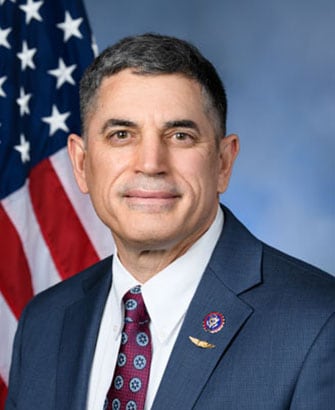
Andrew S. Clyde
R Republican nominee for U.S. House, GA-09
Representative since 2021
Other accounts (1)
The same platforms’ other accounts, such as a congressional office’s or an earlier campaign’s.
- On the ballot
- Won the general electionNov 3, 2026 · 139,335 votes (53.1%)
- Where to vote
- Find your polling place (opens in a new tab) · More ways to vote
- Top priorities
- protecting the Second amendment
- Defending life
- Eliminating taxes
- TAKING CARE OF VETERANS
- Limiting Government
- In Congress
- Representative since 2021 · votes with their party 89% of the time. See the record · Office phone 202-225-9893
- Money
- $738.2K raised, $672.7K spent, $161.5K cash on hand (through Oct 14, 2026). Where it comes from
- Who gives
- 8.3% of individual money from donors at $200 or less · 66% from Georgia · largest committee giver NATIONAL ASSOCIATION OF REALTORS POLITICAL ACTION COMMITTEE, $10K
- Outside groups
- $52.4K supporting, $44.4K opposing Clyde
- Sponsored most in
- Government Operations and Politics, Crime and Law Enforcement, Finance and Financial Sector
5 priorities from clyde4congress.com, in the order they are listed there. Every heading and the text under it is copied exactly, as one passage for each page it is from, and links to that place on the page; hover a source to see which passage it opens.
"I fought terrorists in the deserts of Iraq, ↗ (opens clyde4congress.com at this heading)
The Second Amendment of our Constitution is the teeth in “We the People”, and it must never be compromised by the government. As a veteran and the proud owner of Clyde Armory, Andrew is a staunch supporter of our Second Amendment.
source ↗ (opens the page at this passage) · clyde4congress.com
The Problem: ↗ (opens clyde4congress.com/secondamendment at this heading)
The Constitutional Gun Rights of American citizens, enshrined in the 2nd Amendment, have been losing ground since the Revenue Act of 1918 imposed a 10 percent tax on the sale of firearms. In 1934, the National Firearms Act imposed a flat $200 tax on the transfer of new categories of firearms like short-barreled rifles, short-barreled shotguns, machine guns, and silencers/sound suppressors. In 1937, the Federal Aid in Wildlife Restoration Act (often called the Pittman-Robertson Act) increased the tax on ammunition and rifles to 11%. Now, some cities like Seattle, WA have implemented a $25 tax on every firearm sold and up to a 5-cent tax on every round of ammunition sold. Territories like the Northern Mariana Islands implemented a $1,000 tax on the sale of every handgun in 2016 when their outright ban was struck down by the courts.
So the question needs to be asked, “How can a Constitutional right be taxed?” If it can be taxed then it is no longer an inalienable right but only a privilege to be enjoyed only by those who can afford to pay the tax. In 1819, the Chief Justice of the Supreme Court stated that the "power to tax includes the power to destroy." So, If the Second Amendment can be legally taxed, then it can be taxed out of existence by raising the tax so high that no average citizen can afford it. This would effectively eliminate the right to keep and bear arms.
The Foundation for Victory: ↗ (opens clyde4congress.com/secondamendment at this heading)
In 1966, in Harper v. VA Board of Elections, the U.S. Supreme Court declared poll taxes to be unconstitutional and thereby set the stage that no individual constitutional right could be taxed. In 2008, ninety years after the first taxation of firearms, the U.S. Supreme Court through the DC v. Heller landmark decision, declared the Second Amendment to be an individual constitutional right. In 2010, the U.S. Supreme Court through the McDonald v. Chicago decision found that the right of an individual to "keep and bear arms," as protected by the Second Amendment, is incorporated by the Fourteenth Amendment and is therefore enforceable against every State.
In 2016 The United States District Court for the Northern Mariana Islands in Murphy v. Guerrero struck down the Mariana Islands' $1,000 tax on handguns as unconstitutional stating that “The Second Amendment protects the right to armed self-defense, which includes the right to acquire such arms……The reason is simple: without the arms, the right would be useless….The principle that a court must protect constitutional rights from extinction by means both direct and indirect has a significant pedigree with the Supreme Court.”
The Solution: ↗ (opens clyde4congress.com/secondamendment at this heading)
- 1) Repeal the excise tax on firearms and ammunition.
- 2) Repeal the National Firearms Act excise tax on firearms
- 3) Pass the Hearing Protection Act (HPA) and deregulate/remove sound suppressors/silencers from the National Firearms Act. Deregulate short-barreled rifles and short-barreled shotguns by adding them to the HPA as well.
- 4) Remove the “Sporting Purposes” test which is currently used to determine the legality of various types of firearms and ammunition. There is NO sporting purposes test in the 2nd Amendment, so why is there one in Federal law? It is an infringement on the “right to keep and bear arms”.
5). Fix the Brady Background System Check problem by eliminating it! The government’s response to the pandemic proved again that the FBI cannot be trusted to properly implement the background check law. The mandatory 3-day safety valve on background checks was completely ignored and many checks were extended beyond a month thereby invalidating the background check and making the person start over. This blatant violation by the FBI completely denied law-abiding citizens their 2A constitutional rights during a national crisis. This is a terrible and dangerous precedent that can only be addressed by complete elimination of the Brady Background check system.
6). Remove the interstate ban on purchasing a handgun. If I can purchase a rifle or shotgun in any state of the union, then why can I not purchase a handgun in any state? This is another chink made in the armor of our “right to keep and bear arms”, just another infringement, and must be repaired by deregulating/eliminating the restrictions on the interstate purchase of handguns.
So, we have a lot of ground to recover, ground that has been lost to gun-grabbing, liberal politicians who have no respect for our God-given, inalienable, constitutional right to keep and bear arms. I will NOT give an inch on the Second Amendment, and I will be the point of the spear in taking back what we have lost and help to ensure we never lose it again.
source ↗ (opens the page at this passage) · clyde4congress.com/secondamendment
Heading as listed on clyde4congress.com ↗ (opens clyde4congress.com at this heading)
Andrew is proudly pro-life and believes life begins at conception and ends at natural death. If we cannot defend the lives of the unborn, then we have lost our way as a nation. As your Congressman, Andrew will always work to protect the lives of our nation's innocent unborn.
source ↗ (opens the page at this passage) · clyde4congress.com
Heading as listed on clyde4congress.com ↗ (opens clyde4congress.com at this heading)
As a nation, we are overtaxed. If Americans are to truly be free, we must drastically decrease taxes and the size of the government those taxes fund. Andrew's tax plan would be simple:
- 1. Eliminate graduated taxes and implement a FairTax system [H.R.25]
- 2. Stop taxation on the production of goods [pass H.R. 25]
- 3. Dismantle the IRS [pass H.R. 25]
source ↗ (opens the page at this passage) · clyde4congress.com
Heading as listed on clyde4congress.com ↗ (opens clyde4congress.com at this heading)
As a former Naval Officer with three combat tours in Iraq and Kuwait, Andrew has seen the sacrifices of the men and women who serve in our nation’s military firsthand. He will make it a top priority to ensure veterans receive the care the government promised them when they took their oath to protect this country.
source ↗ (opens the page at this passage) · clyde4congress.com
Heading as listed on clyde4congress.com ↗ (opens clyde4congress.com at this heading)
Congress has the authority to govern within the 18 articles outlined in the U.S. Constitution. Federal departments or funding for projects that fall outside of those 18 articles, should be eliminated. The Department of Education must go. The Environmental Protection Agency must go. These functions should be left to the States, and you should keep more of your tax dollars.
source ↗ (opens the page at this passage) · clyde4congress.com
Heading as listed on clyde4congress.com ↗ (opens clyde4congress.com at this heading)