Loading this candidate’s profile from the FEC filings and campaign records.
Where They Stand is a nonpartisan guide to everyone running for Congress: their money, their own words and how incumbents voted. Find your ballot →
Candidates › AL-07 race › 2025–2026
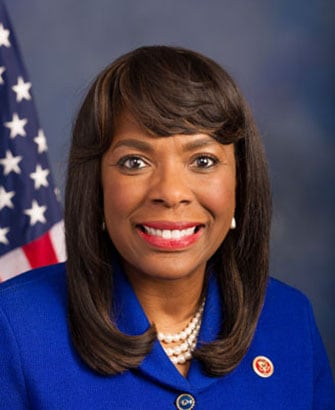
Terri A. Sewell
D Democratic nominee for U.S. House, AL-07
Representative since 2011
Other accounts (3)
The same platforms’ other accounts, such as a congressional office’s or an earlier campaign’s.
- On the ballot
- Won the general electionNov 3, 2026 · 116,255 votes (59.7%)
- Where to vote
- Find your polling place (opens in a new tab) · More ways to vote
- Top priorities
- Affordability
- All Americans deserve access to quality, affordable healthcare
- Voting Rights
- Infrastructure
- Education
- In Congress
- Representative since 2011 · votes with their party 96% of the time. See the record · Office phone 202-225-2665
- Money
- $2.3M raised, $2.4M spent, $3.4M cash on hand (through Oct 14, 2026). Where it comes from
- Who gives
- 18% of individual money from donors at $200 or less · 26% from Alabama · largest committee giver ELEVANCE HEALTH, INC. POLITICAL ACTION COMMITTEE (ELEVANCE HEALTH PAC), $10K
- Outside groups
- $149.7K supporting Sewell
- Backed by
- Professional Fire Fighters of Alabama. As the campaign lists them
- Sponsored most in
- Health, Taxation, Government Operations and Politics
8 priorities from sewellforcongress.com, in the order they are listed there. Every heading and the text under it is copied exactly, as one passage for each page it is from, and links to that place on the page; hover a source to see which passage it opens.
Terri is fighting in Washington to lower the cost of everyday essentials and make life more affordable for Alabama families.
Donald Trump’s reckless tariffs and war with Iran have created an affordability crisis for working families in Alabama. Under Trump, Alabama families are paying an average of $2,700 more for basic living expenses. Terri has consistently opposed policies that increase costs for Alabama families, voting against Republicans’ budget legislation and advocating instead for lowering prescription drug prices, protecting affordable health care, strengthening nutrition assistance, investing in good-paying jobs, and reducing everyday costs for working families.
source ↗ (opens the page at this passage) · sewellforcongress.com/affordability
In Alabama’s 7th Congressional District, over 143,000 renters pay more than half of their monthly income on rent. That is why Terri worked to pass the 21st Century ROAD to Housing Act, which will build more affordable housing in Alabama, lower mortgage and rental costs, prioritize working families over private equity, and increase tenant protections.
source ↗ (opens the page at this passage) · sewellforcongress.com/affordability
Terri is a proud supporter of the Energy Bills Relief Act, which will lower energy costs by cracking down on price gouging, providing assistance to families to make sure their power isn’t shut off, and ensuring that facilities like data centers are paying for their own energy.’
source ↗ (opens the page at this passage) · sewellforcongress.com/affordability
Terri worked with her colleagues to introduce the Stopping a Rogue President on Trade Act, which will stop many of Trump’s tariffs on our allies and require congressional approval for all new tariffs. She also cosponsored the Relief Act to refund Alabama families and small businesses for the Trump tariffs that the courts have found unlawful.
source ↗ (opens the page at this passage) · sewellforcongress.com/affordability
This Congress, Terri reintroduced the Leveling the Playing Field Act 2.0, which would allow for targeted tariffs to protect Alabama’s steelworkers from illegal dumping from China.
source ↗ (opens the page at this passage) · sewellforcongress.com/affordability
Terri believes that all Alabamians should have access to quality, affordable healthcare. Every day, she is fighting back against Donald Trump and MAGA Republicans’ attacks on the Affordable Care Act, Medicare, and Medicaid.
Expanding Medicaid: Terri knows that Alabama must expand Medicaid to close the healthcare coverage gap for working families. She authored the Bridge to Medicaid Act, which would provide a temporary option for healthcare to those caught in the coverage gap in non-Medicaid expansion states like Alabama.
Saving Rural Hospitals: Terri is fighting to save our rural hospitals. Since coming to Congress, she has secured more than $186 million for Alabama’s rural hospitals and $36.9 million for community health centers in AL-07. This year, she introduced the Save Struggling Hospitals Act, which would fix the Medicare payment formulas that do not account for the cost facing hospitals in rural and lower wage areas.
Strengthening our Healthcare Workforce: Terri has championed efforts to train the next generation of our healthcare workforce. She has used her position on the Ways and Means Committee to bring more healthcare professionals to underserved communities by expanding the number of Medicare-supported graduate medical education (GME) slots.
Lowering Drug Prices: Terri fought to cap the cost of insulin at $35 per month for seniors. For the first time in history, we beat the special interests and allowed Medicare to negotiate lower prescription drug prices for our seniors.
Fighting to End Cancer: In 2026, Terri passed the Nancy Gardner Sewell Medicare Multi-Cancer Early Detection Screening Coverage Act. This law will give many seniors new access to cutting-edge screenings that can detect dozens of forms of cancer with a simple blood test.
Improving Rural Medical Transportation: Terri is a leading advocate for improving rural access to medical transportation. She wrote the Protecting Access to Ground Ambulance Act, which would ensure the ground ambulance services in rural and underserved communities are expanded.
source ↗ (opens the page at this passage) · sewellforcongress.com/healthcare
Heading as listed on sewellforcongress.com/healthcare ↗ (opens sewellforcongress.com/healthcare at this heading) · “Healthcare” on sewellforcongress.com/issues ↗ (opens sewellforcongress.com/issues at this heading)
Building a stronger democracy where all Americans have a fair voice ↗ (opens sewellforcongress.com/voting-rights at this heading)
Terri believes that protecting voting rights is the key to building a stronger democracy where we all have a voice. As a daughter of Selma, Terri is guided by her responsibility to protect and defend the rights that the Foot Soldiers of the Civil Rights Movement fought, bled, and died for right here in Alabama’s 7th Congressional District.
source ↗ (opens the page at this passage) · sewellforcongress.com/voting-rights
Donald Trump, the Supreme Court, and Republicans in Alabama want to erase the progress of the last 60 years and return Alabama to the era of Jim Crow. They are using new voter suppression strategies to keep minority voters from having a fair voice in our elections. From strict ID requirements, to polling place closures, to gerrymandering maps to dilute Black voting power – these tactics are designed to silence the voices of Alabama voters and consolidate power.
source ↗ (opens the page at this passage) · sewellforcongress.com/voting-rights
Terri is leading the fight in Congress to restore voting rights after recent attacks by the Supreme Court and the Trump Administration. She is the author of the John R. Lewis Voting Rights Advancement Act, which would restore and expand the protections of the Voting Rights Act while combating the modern day barriers to the ballot box.
source ↗ (opens the page at this passage) · sewellforcongress.com/voting-rights
Trump and Congressional Republicans are trying to pass legislation making it harder for American citizens to vote, including married women, rural and low-income voters, and even veterans. As the Ranking Member of the Elections Subcommittee, Terri is exposing Trump’s voter suppression scheme and organizing opposition to ensure the bill never becomes law.
source ↗ (opens the page at this passage) · sewellforcongress.com/voting-rights
Smart investments in infrastructure give Alabama a competitive edge in today's global economy ↗ (opens sewellforcongress.com/infrastructure at this heading)
Terri has brought billions in federal funding to Alabama to improve our infrastructure and strengthen our communities—both urban and rural. She has fought to rebuild our roads and bridges, fix our broken water and sewer systems, and ensure every Alabamian has access to high-speed internet.
source ↗ (opens the page at this passage) · sewellforcongress.com/infrastructure
Terri has taken bold actions to bring federal funding and resources to Alabama to address the wastewater crisis in the Black Belt.
- Terri introduced the Rural Decentralized Water Systems Reauthorization Act to help combat Alabama’s rural wastewater crisis by strengthening and expanding the existing USDA Rural Decentralized Water Systems Program.
- She secured $5,150,072 for the University of Alabama to improve wastewater conditions in Alabama’s Black Belt. This funding, which was awarded by USDA Rural Development, will be used to provide both technical assistance and construction in 15 Black Belt counties.
- Terri advocated for the inclusion of $1.47 billion for rural water and waste program loans and over $500 million in water and waste grants for clean and reliable drinking water systems and sanitary waste disposal systems.
- Terri secured $10 million from the EPA for a project in Hayneville to address critical sewer and wastewater needs.
- In 2022, Terri invited EPA Administrator Michael Regan to Lowndes County to announce an initiative funded through the Infrastructure Investment and Jobs Act to help fix our broken wastewater system.
- Terri voted to pass the Infrastructure Investment and Jobs Act (IIJA) into law, a once-in-a-generation investment in infrastructure. The law contained $12 billion for clean wastewater and stormwater management systems, including several of Terri’s wastewater initiatives, including:
- Terri’s bill, the Decentralized Wastewater Grant Act, which establishes a new grant program to help low- and moderate-income households connect their homes to existing wastewater infrastructure or install or upgrade individually owned septic tanks.
- Terri secured $782 million for the Alabama State Revolving Fund in the IIJA. This 5-year investment will improve water infrastructure across Alabama and includes $23 billion nationally for the bipartisan Drinking Water and Wastewater Infrastructure Act.
- Terri helped to create the Rural and Low-Income Water Assistance Pilot Program to establish a new EPA program to provide grants to utilities to assist low-income ratepayers.
- Terri worked closely with the Alabama Department of Environmental Management to ensure that state funding received through the American Rescue Plan was allocated for wastewater infrastructure projects. This includes $5 million to fund demonstration sewer projects in the Black Belt.
- Terri secured $5 million for a pilot program to provide grants to a regional wastewater consortium to fund technical assistance and construction of regional wastewater systems by engineering experts at the University of Alabama, University of South Alabama, and Auburn University.
- The Rural Septic Tank Access Act, authored by Terri, passed as part of the 2018 Farm Bill. This newly created USDA program provides grants to improve rural decentralized water systems and water wells.
source ↗ (opens the page at this passage) · sewellforcongress.com/infrastructure
Terri was the only member of the Alabama Delegation to vote in favor of the Bipartisan Infrastructure Investment and Jobs Act (IIJA). This bill is the largest investment in American infrastructure in our country’s history. In Alabama, the law will invest:
- $5.2 billion for Alabama roads
- $225 million for Alabama bridges
- $400 million for Alabama public transportation improvements
- $782 million for water infrastructure in the state
- $100+ million for broadband in Alabama
source ↗ (opens the page at this passage) · sewellforcongress.com/infrastructure
The infrastructure law supported by Terri will invest $76,383,752 to upgrade and expand local transit in Alabama. $11,791,104 of these funds have been allocated for local transit projects in the Birmingham region. This investment will allow local transit authorities to buy new buses and railcars, address repair backlogs, modernize fleets, and transition to new technologies that reduce carbon emissions.
source ↗ (opens the page at this passage) · sewellforcongress.com/infrastructure
In our 21st century economy, access to reliable high-speed internet is not a luxury. It is a necessity. Under the Biden Administration, Terri secured over $1.4 billion to expand high-speed internet access in Alabama. Terri also secured over $18 million in funding to bring high-speed internet to HBCU campuses in Alabama.
source ↗ (opens the page at this passage) · sewellforcongress.com/infrastructure
Our children deserve access to a world-class public-school system that invests in the success of our youngest generation
As the proud product of Selma’s public schools and the daughter of lifelong educators, Terri has made our fight for public education a top national priority. No investment is more fundamental to our future than our investment in our schools, our teachers, and our students.
Stopping Republicans from Eliminating the Department of Education: Donald Trump and Republicans in Congress are trying to dismantle the Department of Education. If successful, their plans could cut hundreds of millions in funding for our children, including direct funding for public school teachers, counselors, nurses, librarians, special education programs, school meals, and afterschool programs.
Protecting our HBCU’s: Alabama’s 7th District is home to many of the most prominent Historically Black Colleges and Universities (HBCUs) in the country. These historic institutions are a modern-day pipeline for minority leaders in the public and private sectors. As Vice Chair of the bipartisan HBCU Caucus, Terri has fought tirelessly for funding to strengthen and preserve our HBCUs.
source ↗ (opens the page at this passage) · sewellforcongress.com/education
In Congress, Terri introduced legislation to close tax loopholes used by wealthy donors to turn a profit off donations to private academies. At a time when our public schools and teachers are struggling to come up with the funds they need to run our classrooms, there is no room for tax giveaways that divert taxpayer dollars away from our public schools.
source ↗ (opens the page at this passage) · sewellforcongress.com/education
Alabama’s 7th District is home to many of the most prominent Historically Black Colleges and Universities (HBCUs) in the country. These historic institutions are a modern-day pipeline for minority leaders in the public and private sectors. As Vice Chair of the bipartisan HBCU Caucus, Terri has fought tirelessly for funding to strengthen and preserve our HBCUs.
source ↗ (opens the page at this passage) · sewellforcongress.com/education
Terri called on the University of Alabama to restore student-run publications that highlight the experiences of women and African American students. The discontinuation of these publicans is a decision with profound implications for free speech, academic freedom, and the University’s stated commitment to fostering an inclusive campus environment. This decision undermines the significant progress made by the University over the last six decades towards fostering a welcoming and inclusive campus environment for all students.
source ↗ (opens the page at this passage) · sewellforcongress.com/education
A voice for our service members, veterans, and military families ↗ (opens sewellforcongress.com/veterans at this heading)
Terri is committed to ensuring that our veterans, service members, and military families have access to the support they have earned through their service to our country.
source ↗ (opens the page at this passage) · sewellforcongress.com/veterans
In Congress, Terri fought for bipartisan legislation to reform the Veterans Administration, including solutions that increase transparency at the VA and allow veterans access to private doctors. No veteran who has put his or her life at risk for the security of our nation should be denied timely and quality care by the VA. In addition to supporting bipartisan legislative reforms like the Veterans’ Access, Choice and Accountability Act, Terri has authored legislative amendments specifically focused on delivering cutting-edge care to veterans living in rural communities.
source ↗ (opens the page at this passage) · sewellforcongress.com/veterans
Terri helped to stop Republican efforts to slash veteran disability benefits and force veterans to pay more to use their VA home loan benefits.
source ↗ (opens the page at this passage) · sewellforcongress.com/veterans
Terri introduced the Improving Access to Prenatal Care for Military Families Act, which would create a Department of Defense (DoD) pilot program to designate pregnancy as a Qualifying Life Event under the TRICARE program, empowering dependents of service members to choose a health care plan that meets their needs during pregnancy.
source ↗ (opens the page at this passage) · sewellforcongress.com/veterans
Terri signed a discharge petition to force a vote on the Major Richard Star Act, a bill that would allow veterans who were forced to medically retire because of combat-related injuries to receive their full retirement pay and disability compensation.
source ↗ (opens the page at this passage) · sewellforcongress.com/veterans
Fighting to protect and strengthen Social Security ↗ (opens sewellforcongress.com/seniors at this heading)
An essential part of the American Dream is being able to have a stable and comfortable retirement. I believe that should be within reach for every Alabamian.
That is why I am a co-chair of the Expand Social Security Caucus, a group of Democrats who have committed to protecting and expanding Social Security benefits. Social Security is a promise to our nation’s workforce that no one gets left behind, and millions of Americans rely on Social Security to better support themselves in retirement.
I also use my position on the Ways and Means Committee to protect Medicare benefits for our seniors and to look for ways to secure private retirement savings for those that have invested a lifetime working toward financial security.
source ↗ (opens the page at this passage) · sewellforcongress.com/seniors
The historic sites of Alabama's 7th Congressional District are national treasures which must be preserved
The story of Alabama’s 7th District is the story of our fight for civil rights and voting rights for all Americans. By preserving that story and sharing it with the public, we can cultivate a stronger understanding of our nation’s history and generate economic growth here at home.
From the Edmund Pettus Bridge to the 16th St. Baptist Church, I have led the fight to bring federal preservation efforts and investment home to Alabama. My office has helped historic sites right here in Alabama win more than $13 million in Historic Preservation Grants through the National Park Service. In our state’s rural Black Belt, I have led the fight to save Selma’s historic federal courthouse and to secure funding for the Selma Interpretive Center.
In Congress, I introduced legislation, supported by the entire Alabama congressional delegation, urging the creation of a national civil rights monument in Birmingham. As one of his final acts in the White House, President Obama followed our recommendation and used his executive power to create the Birmingham Civil Rights National Monument.
I have also introduced and passed amendments to the federal budget, increasing funding for historic preservation efforts on HBCU campuses by $40 million. Alabama’s 7th District is home to some of the most prominent HBCUs in the country, and I will continue fighting to preserve the civil rights and voting rights sites at these historic institutions.
Together, it is our job to protect the historic sites of Alabama’s 7th District. The future of our district depends on our fight to preserve its history.
source ↗ (opens the page at this passage) · sewellforcongress.com/historic-preservation